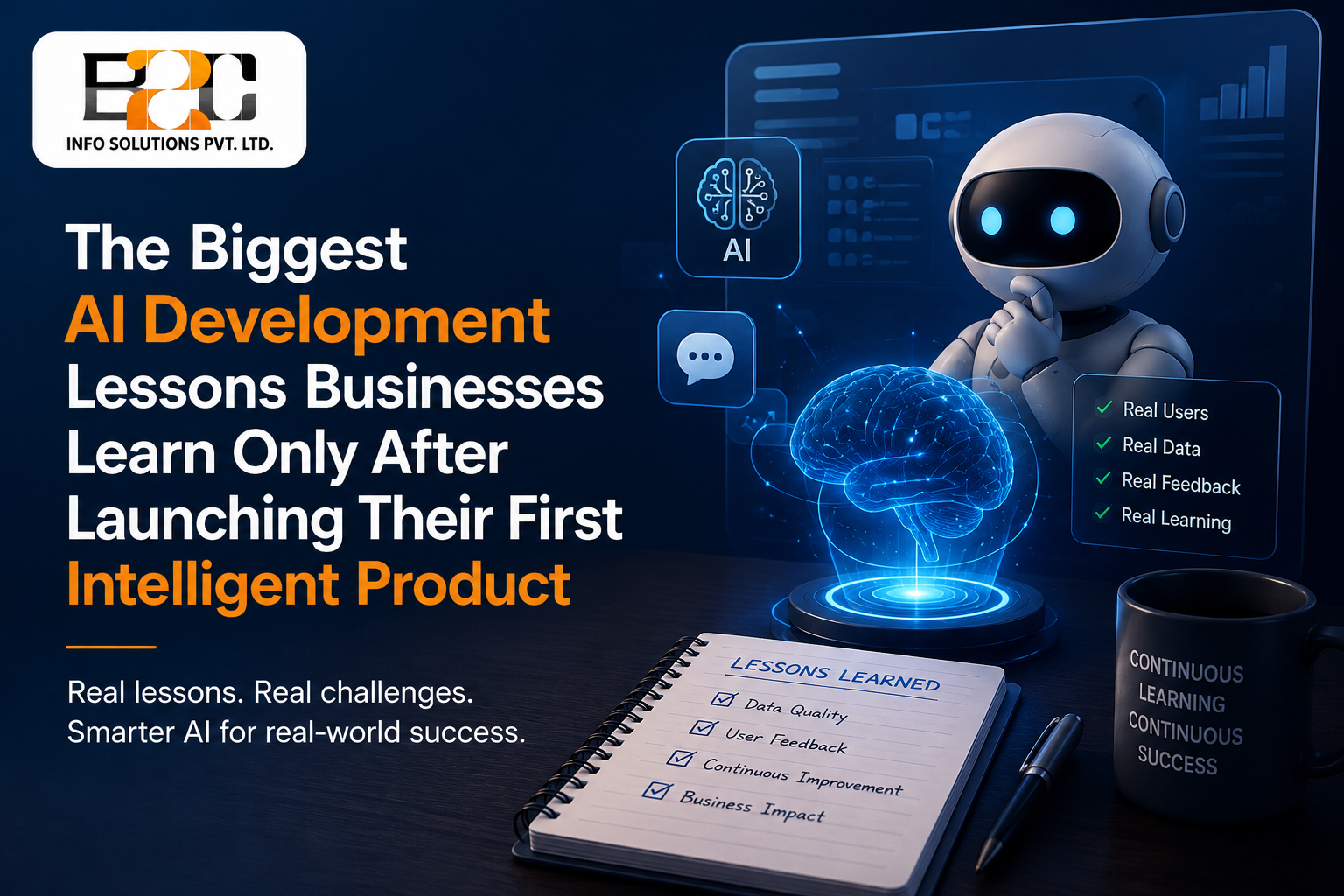
Launching an intelligent product feels like the finish line, but for most businesses it is closer to the starting point. Teams spend months on model selection, data preparation, and interface design, then discover that the real lessons only surface once real users start interacting with the system in unpredictable ways. This is a pattern that any experienced AI Development Company in India will recognize immediately, because the gap between a working prototype and a genuinely useful product almost always shows up after launch, not before it. Understanding this gap early can save businesses from repeating the same expensive mistakes on their second or third AI initiative, and it often shapes how quickly a company can move from a single successful pilot to a broader portfolio of intelligent products.
Pre-launch planning tends to focus on what a system should be able to do in theory: the features it will support, the accuracy it should achieve, the integrations it needs. Post-launch reality focuses on what actually happens when real users, real edge cases, and real data volumes meet that plan. Gartner has noted that many AI projects that perform well in controlled testing environments struggle to maintain the same performance once deployed at scale, largely because production data is messier and more varied than training data. McKinsey's research on AI adoption similarly points out that organizational readiness, not just technical readiness, determines whether an AI product actually gets used. A model can be statistically accurate and still fail commercially if it does not fit naturally into how people already work.
The first lesson most businesses learn is that data quality problems are far more common in production than anticipated, even after extensive testing. Missing fields, inconsistent formatting, and unexpected input patterns from real users routinely expose gaps that a clean training dataset never revealed. The second lesson is that user trust builds slowly and breaks quickly. A single confidently wrong answer from an AI system can undo months of positive user experience, which is why explainability and clear confidence signals matter as much as raw model accuracy. The third lesson involves scope. Teams frequently discover that the most valuable version of their product is narrower than originally planned, focused on one workflow done well rather than several done adequately. Businesses that partner with a team skilled in AI product development tend to reach these insights faster because they have already seen similar patterns across other deployments. A fourth, less obvious lesson is that internal adoption often lags external enthusiasm. Employees who were not involved in building a new AI tool sometimes resist changing established habits, even when the tool measurably improves outcomes, which means change management deserves as much attention as the underlying technology itself.
Several recurring mistakes slow AI adoption after launch. One is treating the AI system as a finished product rather than a component that needs ongoing tuning as user behavior and data patterns shift over time. Another is underestimating integration complexity, since connecting an AI feature to existing enterprise software often takes longer than building the model itself. A third mistake is insufficient monitoring, where teams have no reliable way to detect when model performance quietly degrades. Deloitte has highlighted that responsible AI practices, including ongoing bias and performance monitoring, are increasingly viewed as a governance requirement rather than an optional safeguard. Skipping this step does not just create technical debt, it creates business risk that often surfaces at the worst possible time. A less discussed but equally damaging mistake is launching without a clear owner for the AI system once the initial project team disbands, leaving no one accountable for retraining schedules or performance reviews.
Perfect planning cannot anticipate every real-world scenario, which is why continuous learning matters more than getting the initial design exactly right. Products that build in structured feedback loops, where user corrections and outcomes feed back into model refinement, tend to improve steadily after launch even if their first version was imperfect. This is fundamentally different from traditional software development, where a feature typically works the same way indefinitely once shipped. AI systems behave more like living systems that require ongoing observation. Businesses that invest in AI implementation services built around iterative improvement, rather than a single fixed release, are generally better positioned to adapt as user needs and data patterns evolve.
Adoption patterns vary meaningfully across industries. In financial services, AI adoption has concentrated on fraud detection and personalized customer support, areas where clear, measurable outcomes justified early investment. Retail and e-commerce businesses have focused on recommendation engines and demand forecasting, both of which offer fast, visible feedback on model performance. Healthcare organizations have moved more cautiously, prioritizing administrative automation and diagnostic support tools that assist rather than replace clinical judgment, reflecting the sector's higher regulatory bar. IDC and Statista data on enterprise technology adoption consistently show that industries with clear, quantifiable outcomes tend to scale AI initiatives faster than those where success is harder to measure. This cross-industry pattern reinforces a simple principle: AI adoption accelerates wherever value is easiest to prove, and it slows wherever outcomes are ambiguous or difficult to attribute directly to the technology itself.
Building AI products that continue to improve requires structured practices from day one. Establishing clear metrics for both technical performance and business impact prevents teams from optimizing a model for accuracy while missing whether it actually improves outcomes for users. Maintaining a feedback pipeline that captures real user corrections, not just automated logs, gives teams the signal needed to retrain models meaningfully. Version control for models and datasets, much like version control for code, allows teams to trace exactly what changed when performance shifts unexpectedly. Cross-functional review, involving both technical and domain experts, helps catch issues that a purely technical team might miss. These practices form the foundation of AI lifecycle management, turning a single launch into a sustainable, improving product. Regular retraining schedules, paired with a clear rollback plan if a new model version underperforms, give teams the confidence to keep iterating without risking the stability users have come to rely on.
The next generation of intelligent products is likely to rely more heavily on AI agents capable of completing multi-step tasks autonomously, rather than simple assistants that answer isolated questions. Businesses are also expected to place growing emphasis on responsible AI, as regulators in multiple regions move toward clearer accountability standards for automated decision-making. AWS, Microsoft, and Google have each continued expanding their enterprise AI tooling, suggesting that the infrastructure supporting these more advanced systems will keep maturing quickly. Companies preparing for this shift are investing now in clean data architecture and flexible integration layers, recognizing that the businesses best positioned for the next wave are the ones that treated their first AI product as a foundation rather than a finished destination. Organizations exploring enterprise AI transformation today are effectively preparing for that next stage in advance.
The lessons that follow a first AI product launch are rarely comfortable, but they are almost always valuable. Data quality gaps, integration friction, and the need for continuous refinement are not signs of failure, they are the normal cost of building something genuinely new. Businesses that treat these lessons as input for the next iteration, rather than reasons for hesitation, tend to build stronger, more trusted AI products over time. For teams preparing to launch their first intelligent product, or refining one already in the market, it is often worth taking the time to Contact our AI specialists before committing to the next phase of development. The businesses that learn fastest after launch are usually the ones that end up leading their industry.
Production environments involve messier data, unpredictable user behavior, and edge cases that controlled testing rarely captures fully, which is why performance often shifts once a product reaches real users.
Treating the AI system as a finished product rather than an evolving one is among the most common mistakes, since models require ongoing monitoring and tuning as data patterns change over time.
Investing in clean data architecture, flexible integrations, and responsible AI governance now helps businesses adapt more easily as more advanced AI agents and automation capabilities continue to mature.
Author Bio
JS Tomar is the Global Business Head at B2C Info Solutions, a premium digital technology company that has delivered over 1000+ web and mobile projects worldwide. With a deep background in strategic formulation and product engineering, he specializes in helping businesses leverage AI, cloud, and experience design to build disruptive software solutions. Based in Noida, JS is dedicated to nurturing a culture of excellence and delivering high-value digital transformations for clients across North America, Europe, and the Middle East.

 4 North
  52 Cornmarket
  C-25, C Block, 91springboard
 #02 - 161 IMM Building