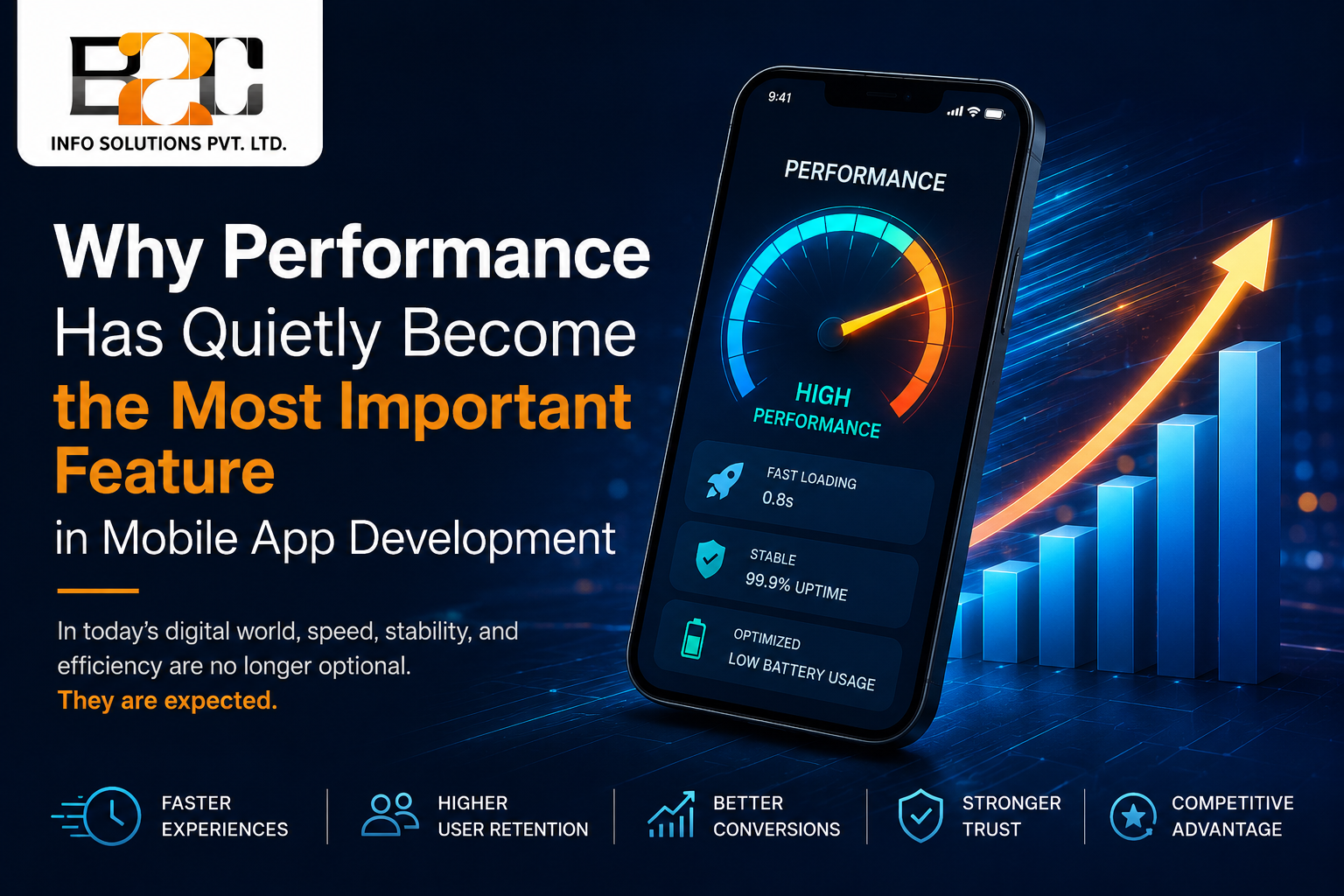
For years, mobile app strategy centered on features, design, and marketing reach. Performance was treated as a technical detail, optimized quietly in the background. That assumption no longer holds. Speed, responsiveness, and reliability have become the features users notice first, even when they cannot say exactly why an app feels good or bad to use. A capable Mobile App Development Company India now treats performance as a design decision made at the start of a project, not a fix applied after launch.
This shift matters because performance now directly influences whether users stay, convert, or abandon an app within the first few seconds. This article explains why performance has become so central, what it costs businesses when overlooked, and how high performing organizations build it into every stage of development.
Several forces have combined to push performance to the top of the priority list. Networks have become faster on average, which paradoxically raises expectations rather than lowering them, since users now notice delays that used to feel normal. Devices themselves have grown more powerful, meaning slow apps can no longer be blamed on hardware limitations alone.
Consumer behavior has shifted as well. According to Google's own research on mobile web and app performance, users form judgments about quality within the first few seconds of interaction, and slow experiences directly correlate with higher abandonment rates. App store competition has also intensified, with data from Sensor Tower and Appfigures consistently showing enormous numbers of apps competing for the same categories of user attention, leaving little patience for one that lags or takes too long to respond.
Poor performance rarely announces itself with a single dramatic failure. More often, it erodes a business gradually through small frictions that compound over time. Slow load times increase abandonment during onboarding, reducing the pool of users who ever experience an app's core value. Laggy interactions during checkout or booking flows create hesitation at the exact moment a business most needs user confidence.
There is also a reputational cost that is harder to measure but just as damaging. App store reviews frequently mention speed, and negative reviews about performance can suppress downloads long after the underlying issue is fixed. Support teams absorb additional cost too, since users experiencing problems are more likely to contact support or simply churn without explanation.
Perhaps the least visible cost is opportunity cost. Engineering time spent firefighting performance issues after launch is time not spent building new capabilities, placing performance focused competitors at a structural advantage over time.
Several technical factors combine to shape how fast and reliable an app feels in practice.
Each factor interacts with the others, which is why performance optimization requires a holistic view rather than isolated fixes.
Apps that consistently perform well gain advantages that compound over time. Higher retention rates are the most direct benefit, since users are far more likely to return to an app that feels fast and reliable. Better app store ratings often follow, which improves organic discoverability and reduces reliance on paid acquisition.
Performance also strengthens brand perception in ways that are easy to underestimate. Users tend to associate a fast, smooth app with a more trustworthy, professional business, even when the connection is not entirely rational. This halo effect can influence how users perceive a company's other digital properties as well.
Organizations building enterprise mobile applications increasingly treat performance benchmarks as a core success metric alongside feature completion, recognizing that a technically impressive app which performs poorly will still lose users to a simpler, faster competitor.
Several industry trends are reinforcing the shift toward performance first development. Cross platform frameworks such as Flutter and React Native have matured considerably, narrowing the performance gap that once existed between cross platform and fully native applications. This allows teams to move faster without sacrificing as much speed or responsiveness as in earlier years.
Firebase and similar mobile backend platforms have made real time performance monitoring far more accessible, allowing teams to catch regressions before they affect a large share of users. Analysts at Gartner and IDC have both highlighted continued enterprise investment in mobile infrastructure, reflecting how central performance and reliability have become to overall digital strategy rather than a purely technical concern.
Android Developers documentation and Apple's own developer guidance have also placed growing emphasis on performance best practices, including stricter recommendations around startup time, memory management, and battery efficiency, which signals how seriously platform providers themselves treat this issue.
Building consistently fast, reliable apps requires deliberate practices woven into the entire development lifecycle.
Teams that apply these practices consistently, rather than only during major releases, tend to maintain stronger performance over the long term.
Looking ahead, performance expectations will likely keep rising rather than plateauing. AI powered features are becoming more common inside mobile apps, and users will expect these capabilities to feel instantaneous rather than introducing new lag. This places additional pressure on teams to optimize on device processing and minimize unnecessary round trips to cloud services.
Edge computing and smarter caching strategies are likely to play a larger role as well, reducing the distance data has to travel and improving responsiveness for users regardless of location. At the same time, platform providers will likely continue raising minimum performance thresholds required for favorable app store placement, making performance a factor in discoverability as well as user experience.
Organizations that build performance into their culture, supported by strong application performance optimization practices, will be far better positioned than those that treat it as a late stage concern addressed only after users start complaining.
Performance has moved from a background technical concern to one of the most important features a mobile app can offer. Users judge apps within seconds, competition is intense, and the businesses that consistently deliver fast, reliable experiences earn stronger retention, better reviews, and greater long term trust. Treating performance as a core design decision, rather than an afterthought, is no longer optional for organizations that depend on mobile as a meaningful part of their business. For teams planning a new build or looking to improve an underperforming app, it is worth seeking experienced guidance early. Reaching out to Contact our mobile app experts can help clarify where performance gaps exist and what practical steps will deliver the most impact.
Why does mobile app performance matter so much today?
Users judge an app's quality within seconds, and with intense app store competition, slow or unreliable experiences quickly lead to abandonment and lost trust.
What are the biggest factors affecting mobile app performance?
Startup time, network efficiency, rendering smoothness, memory and battery usage, and backend response time combine to shape how fast and reliable an app feels.
How can businesses improve mobile app performance over time?
Businesses can improve performance by setting measurable benchmarks, monitoring apps continuously in production, optimizing backend response times, and treating regressions as release blockers.
Author Bio
JS Tomar is the Global Business Head at B2C Info Solutions, a premium digital technology company that has delivered over 1000+ web and mobile projects worldwide. With a deep background in strategic formulation and product engineering, he specializes in helping businesses leverage AI, cloud, and experience design to build disruptive software solutions. Based in Noida, JS is dedicated to nurturing a culture of excellence and delivering high-value digital transformations for clients across North America, Europe, and the Middle East.

 4 North
  52 Cornmarket
  C-25, C Block, 91springboard
 #02 - 161 IMM Building