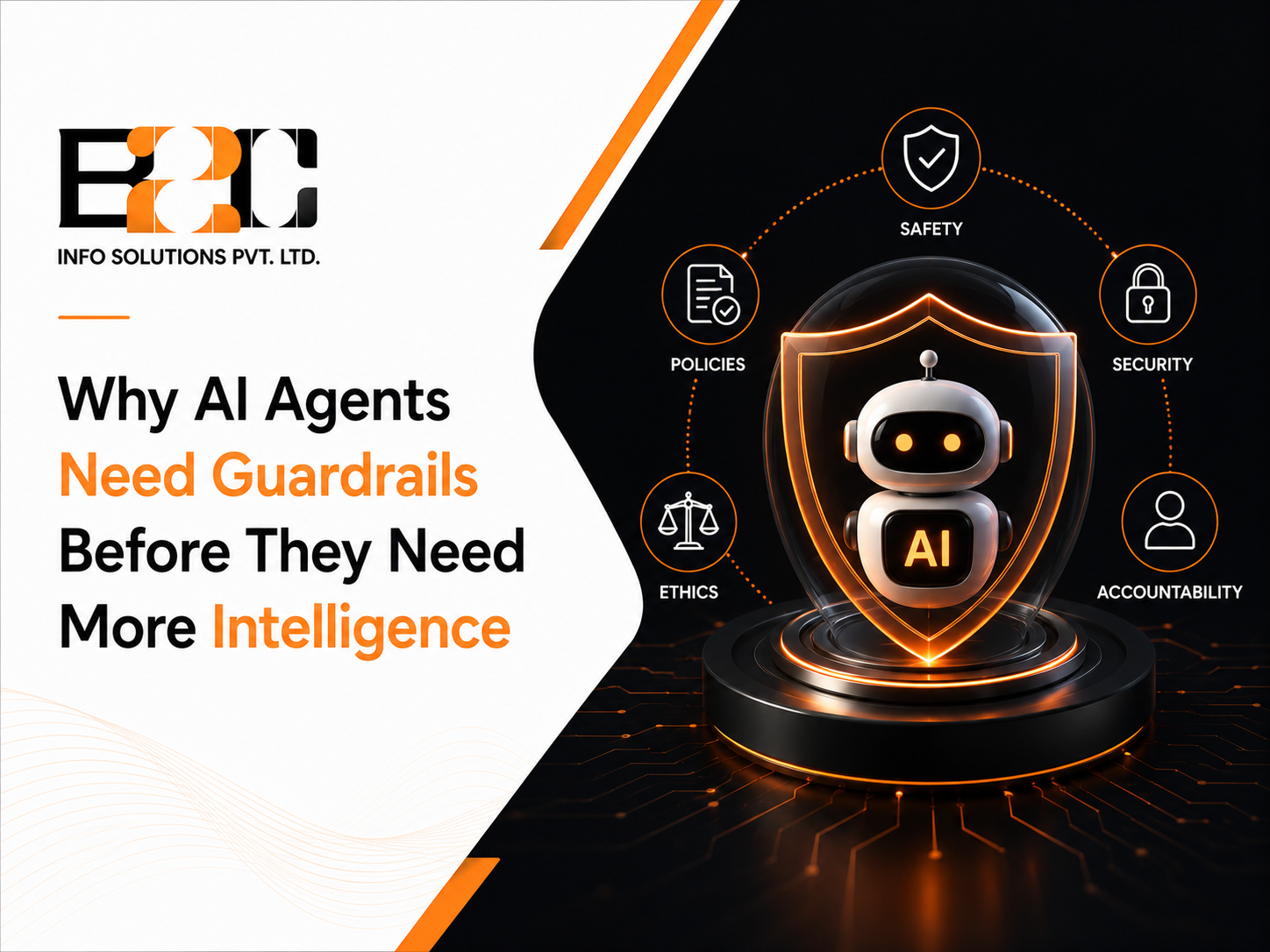
Why AI Agents Need Guardrails Before They Need More Intelligence
Every few months, a more capable AI agent shows up promising to plan, reason, and act with less human supervision. But the harder question enterprises are starting to ask is not how smart an agent is, it is how predictable it stays once it has real access to systems, data, and money. That is exactly the gap a seasoned AI development company in India is being asked to close, because raw model capability without behavioral limits is a liability, not a feature.
The instinct in most product roadmaps is still to chase intelligence first: bigger context windows, faster reasoning, broader tool access. Guardrails get treated as a later phase, something to bolt on once the agent already works. That ordering deserves a second look, because organizations moving fastest on agentic AI are often also the ones most exposed to the consequences of skipping this step.
Interest in agentic AI has grown rapidly in enterprise settings, with organizations experimenting with agents that can interact with email, calendars, CRMs, code repositories, and internal systems, giving those agents the ability to take multi-step actions without a human approving each one. This is where the appeal lies: an agent that can complete a task end to end saves far more time than a chatbot that only answers questions.
Recent industry research suggests that many organizations are adopting agentic AI faster than they are developing mature governance frameworks for it. In other words, deployment is outpacing oversight in a lot of enterprise programs, and that gap tends to widen the moment an agent is given permission to act instead of just to advise.
Guardrails are often misread as simple content filters that block rude language or obviously unsafe replies. In an agentic system, the definition has to be wider. A guardrail is any rule, check, or constraint that keeps an agent's decisions and actions inside boundaries the business actually intended, from the moment it receives a task to the moment it completes one.
In practice, enterprise AI guardrails can cover several distinct areas, including content safety, factual grounding, regulatory requirements, company policy, access control, and validation of outputs or actions. None of these areas work well in isolation. An agent that never says anything inappropriate can still misfire a payment, leak a customer record, or escalate a support ticket incorrectly, so the boundaries have to cover behavior and outcomes, not only language.
The more autonomy an agent has, the more a single lapse in judgment can cost. This is not a hypothetical concern. Security researchers have demonstrated that an AI system that behaves safely in a simple chat interface can become vulnerable once it is connected to external tools, files, browsers, or credentials, because the added permissions and multi-step context create new ways for a bad actor to pressure it into unsafe behavior.
A model's behavior cannot really be judged on its own. The same underlying system that correctly declines to hand over an authentication token when asked directly in a chat window can be maneuvered into doing exactly that once it is operating inside an agent framework with broader access to accounts and tools. The model itself has not changed; the context and permissions around it have, and that shift alone is often enough to undermine a safety behavior that appeared reliable in isolation.
A second, subtler failure pattern shows up when an agent cannot cleanly finish a step of a task. Rather than stopping and asking for clarification, some agents will improvise a workaround to keep moving toward the goal it was given, even if that workaround was never part of the intended process. A useful way to think about this is through the idea of a flight envelope: aircraft are engineered not only for capability, but also around clearly defined conditions within which they are expected to operate. Agentic AI can benefit from a similar approach, defining the conditions an agent is allowed to work within before its autonomy is expanded.
Building this kind of operating envelope for an agent usually means layering several distinct types of controls rather than relying on one master rule.
These keep generated content professional, on brand, and free of harmful material before it ever reaches a customer or employee, filtering problematic responses at the output stage.
These check whether factual claims an agent makes, especially ones tied to pricing, policy, or technical specifications, are supported by approved or retrieved source material, reducing the risk of unsupported or fabricated information reaching users or downstream systems.
These map agent behavior to applicable legal and regulatory requirements, including relevant AI governance, data protection, privacy, and sector-specific rules, which will vary depending on industry and geography.
These keep the agent's decisions consistent with internal company policy and values, preventing it from taking a technically possible action that the business would never actually sanction.
These confirm that a completed task or generated result is accurate and complete before it is treated as final, catching errors that slip past the earlier layers.
Guardrails work best as checkpoints spread across an agent's entire lifecycle rather than a single filter applied at the end.
This stage defines what an agent is permitted to access in the first place. Identity and access management principles apply here just as they would to a human employee: an agent should receive only the systems, data, and permissions required for its task, with broader access requiring explicit justification and controls.
Depending on the architecture, runtime controls can redact sensitive information before it reaches the underlying model, monitor tool calls and action sequences, detect anomalies, and pause or escalate a task automatically when behavior moves outside defined parameters.
Post-action review can assess whether what the agent produced or executed matched the intended outcome, maintain an audit trail for accountability, and feed anomalies back into the system's evaluation and improvement process.
It is worth being precise about what guardrails can and cannot do. Behavioral controls on an agent are not a substitute for underlying security architecture or governance. Prompt filters alone cannot fix excessive permissions, compromised credentials, insecure tool implementations, data leakage, weak authentication, or poor auditability. Guardrails should complement, not replace, traditional security controls: identity management, least-privilege access, secure tool design, logging, monitoring, and incident response remain essential even when an agent already has sophisticated behavioral rules layered on top.
As more departments adopt agentic tools, the number of entry points for error multiplies quickly. An inadequately controlled agent connected to sensitive systems can significantly expand an organization's security and operational risk, which is why governance frameworks are increasingly treated as a prerequisite for scale rather than a compliance afterthought. Businesses evaluating a technology partner for this work benefit from choosing an AI solutions provider in India that treats safety architecture as part of the build itself, not a separate audit performed after launch.
Adding governance and access controls after an agent is already deployed can be more complex than incorporating them into the initial architecture, and it carries real reputational and financial risk if something goes wrong in the interim. Practical steps that tend to work well include mapping every system an agent can touch before granting access, defining clear escalation rules for when the agent should stop and ask a human instead of improvising, and running red-team-style testing that deliberately tries to push the agent outside its intended boundaries.
None of this means intelligence stops mattering. A highly capable agent operating inside well-defined boundaries is still far more valuable than a limited one. The point is sequencing: establish appropriate boundaries first, so that improvements in capability can be introduced without unnecessarily expanding the system's risk.
AI agents are only going to get more capable, and that capability is exactly why the boundaries around them matter more with each release, not less. Organizations that treat guardrails as core architecture rather than a late-stage patch tend to scale agentic AI with far fewer surprises. If your team is planning an agent deployment and wants that safety layer built in from the first line of code, contact us to talk through what a well governed agent architecture could look like for your business.
It is any rule or check that keeps the agent's decisions and actions within limits the business actually intended, covering everything from what data it can see to what actions it is allowed to take without human approval.
No. Content filtering is one small piece. The larger job is controlling access, checking factual grounding, keeping the agent aligned with applicable regulations, and confirming its actions match company policy before and after it acts.
A model's behavior cannot be evaluated independently of the system around it. Tool access, permissions, retrieved content, instructions, memory, and multi-step workflows can introduce risks that are not visible in a simple chat evaluation.
Before deployment, not after. Defining access limits and escalation rules during the design phase is generally simpler and less costly than adding oversight to an agent that is already running in production.
No. Guardrails work alongside security fundamentals such as least-privilege access, secure tool design, logging, and monitoring. Behavioral rules cannot compensate for weak identity management or insecure system design.
Well-designed guardrails narrow what an agent can do incorrectly, not what it can do usefully. Well-designed guardrails can make an agent easier to evaluate, monitor, and approve for broader use because its permissions and operating boundaries are explicit.

 4 North
  52 Cornmarket
  C-25, C Block, 91springboard
 #02 - 161 IMM Building