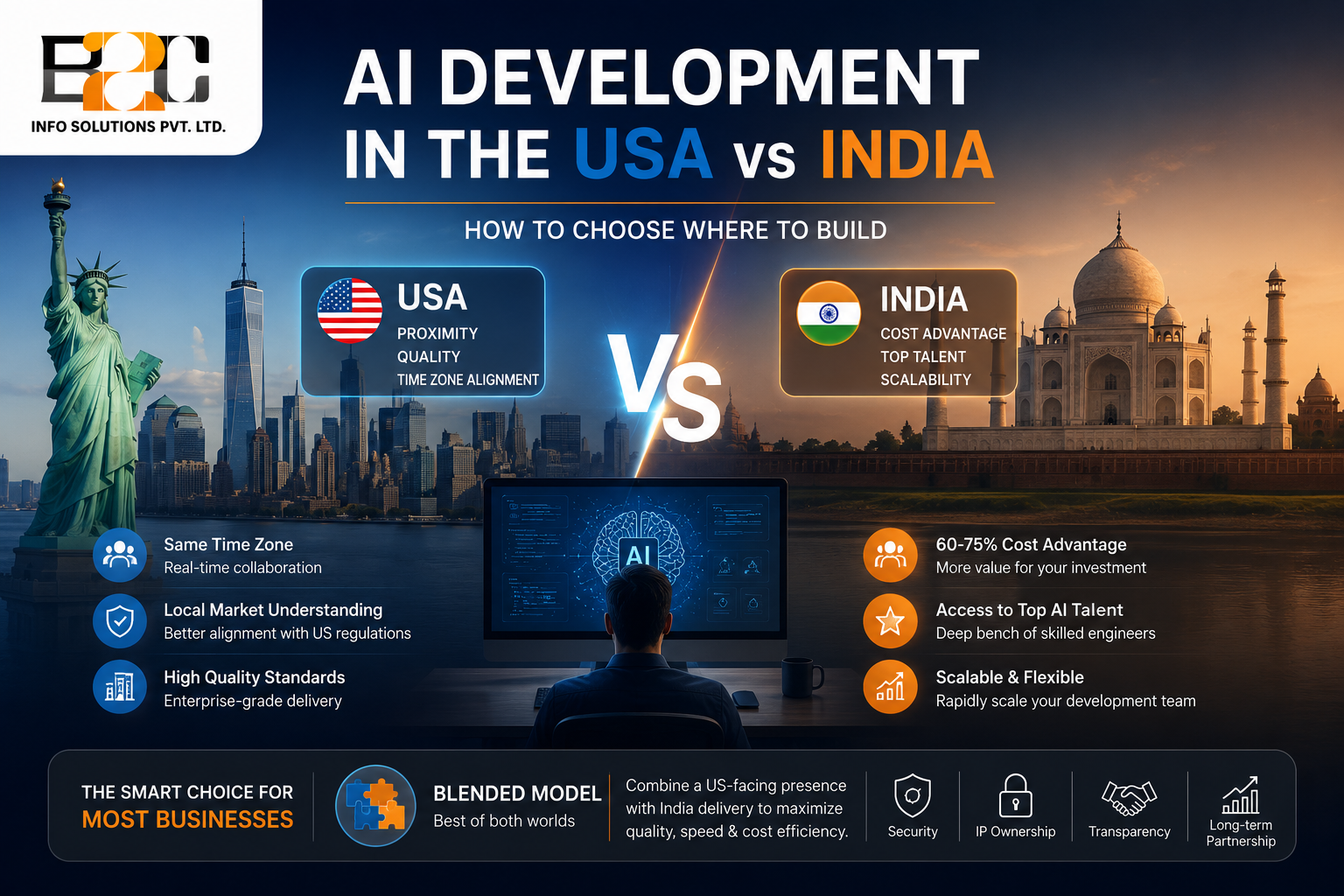
Quick answer: Choosing between AI development in the USA and India comes down to a trade off between proximity and price. A US based team offers same time zone collaboration and local market fluency, while an India based team offers senior engineering at a much lower cost. For most businesses the strongest option is a blended model that combines a US facing presence with delivery from India, capturing both advantages at once.
Where you build your artificial intelligence is not a minor procurement detail. It shapes how fast you can move, how much of your budget reaches the actual engineering, how easily you can meet regulatory obligations, and how much of your working day overlaps with the team. Because AI projects are iterative, with frequent decisions about data, model behaviour, and integration, the friction or ease of that collaboration compounds over the life of the project. Getting the location right early saves both money and months.
It is also a decision that has changed in recent years. The rise of hosted foundation models means that much of the heaviest lifting, the model itself, is now shared infrastructure that any competent team can access through an API. That has shifted the real differentiator from raw model building to engineering quality, data handling, and integration skill, all of which are available in both markets. The question is therefore less about capability and more about cost, proximity, and fit.
A US based AI development partner brings advantages that matter most when closeness counts. You share a time zone, so decisions happen in real time rather than across an overnight gap. The team understands the local market, its customers, and its regulatory environment, which helps when the product is aimed squarely at American users. And for regulated sectors, a US presence can simplify conversations about data residency and compliance frameworks such as HIPAA, SOC 2, and CCPA.
The trade off is cost. Senior AI engineers in the United States command some of the highest salaries in the technology sector, and that flows directly into project budgets. For a well funded enterprise building a core, sensitive system, that premium can be justified. For a startup or a mid sized business watching every dollar, it often means a smaller scope, fewer experiments, and a slower path to a working product.
Businesses that want that local footprint can work with an AI development company in the USA that pairs a US facing presence with globally distributed delivery, which softens the cost penalty considerably.
India has become the default destination for AI delivery, and the reason runs deeper than price alone. The country produces an enormous pool of engineering and data graduates each year, so senior AI, machine learning, and data talent is genuinely available rather than locked behind a long hiring queue. Delivery happens in English, processes are mature, and rupee based rates mean the same budget stretches across a full roadmap, parallel pilots, and proper testing rather than one cautious experiment.
The often cited concern is the time difference, but in practice a professional partner manages it deliberately. A fixed daily overlap window, written end of day updates, and clear milestone reporting keep a Western client fully informed without late night calls. Many companies find that the overnight gap becomes an advantage, since work progresses while they sleep and lands ready for review in the morning.
An established AI development company in India such as B2C Info Solutions delivers the full scope, from strategy and data engineering through model building, integration, and ongoing operations, with full IP ownership assigned to the client by contract and data handled under India's DPDP Act and ISO 27001 practices.
The table below sets the two options against the factors that most influence the decision. Neither column is universally better; the right choice depends on which rows matter most to you.
|
Factor |
AI development in the USA |
AI development in India |
|---|---|---|
|
Cost per senior engineer |
High, among the world's highest |
A fraction, with comparable skill |
|
Time zone |
Same as US clients |
Overnight gap, managed with overlap |
|
Talent availability |
Scarce and heavily contested |
Deep and readily available |
|
Local market context |
Strong for US products |
Strong, with global delivery experience |
|
Compliance familiarity |
Native to US frameworks |
Aligned with global standards and DPDP |
|
Speed to a staffed team |
Slower, hiring is hard |
Days to weeks from an existing bench |
|
Budget reach |
Fewer experiments per dollar |
Full roadmap within the same budget |
It helps to translate the rate gap into what it actually buys. Suppose two teams of similar seniority are set the same brief: a grounded support assistant, a demand forecasting model, and the integration work to connect both to your systems. In the United States, the engineering cost alone can consume most of a modest budget, leaving little room for the experimentation that good AI work depends on. With an India based team of comparable skill, the same budget covers the three deliverables and still leaves headroom for a second pilot, a longer testing phase, and a proper monitoring setup after launch.
That difference matters because AI rarely succeeds on the first attempt. Data needs cleaning, model behaviour needs tuning, and the first version of a feature often teaches you what the second should be. A budget that allows for iteration produces a better result than one spent entirely on a single cautious build. This is the quiet advantage of the lower cost base: not just a cheaper project, but more attempts to get it right. The parity in engineering quality is what makes the saving real rather than a false economy, provided the partner has a genuine track record.
Rather than a single answer, it helps to match the choice to your situation. Three common scenarios cover most businesses.
Proximity and local context outweigh cost. This fits a regulated enterprise building a sensitive core system, a company that needs constant same time zone collaboration, or a product so tied to the US market that local fluency is decisive. Here the premium buys genuine value.
Budget, scale, or speed of staffing is the priority. This fits startups stretching runway, mid sized firms running several AI initiatives at once, or any business that wants senior engineering without the Western salary. The saving frees budget for more experimentation and a faster path to production.
You want both, which is most companies. A US facing presence handles proximity, market context, and stakeholder communication, while delivery from India provides the engineering depth at lower cost. This hybrid captures the strengths of each market and is why so many providers now operate exactly this way.
Location sets the trade off, but it does not guarantee quality. The same fundamentals separate a strong partner from a weak one in either market. Look for a portfolio of relevant, live AI work rather than slideware. Expect a clear process with data readiness, a focused proof of concept, and validation against a metric agreed up front. Require full ownership of the code, models, and data in writing, backed by an NDA. And check that data governance, encryption, access control, and bias testing are built in rather than promised. A partner that meets these tests in India or the USA will serve you well; one that fails them will disappoint at any price point.
Yes. Indian teams typically deliver comparable AI development at 60 to 75 percent less than US rates, because operating costs are lower and the talent pool is large. Quality holds when you choose an experienced partner with a relevant track record.
It does not when the partner manages it deliberately with a daily overlap window and written updates. Many clients find the overnight gap useful, since work advances while they are offline and is ready for review the next morning.
Yes, through a blended model. A US facing presence handles time zone and market context while delivery runs from India, giving you proximity where it matters and lower cost on the engineering.
It should not. A professional partner in either country assigns full ownership of the code, models, and data to you by contract. Always confirm this in writing before the project begins.
The choice between AI development in the USA and India is a trade off between proximity and price, and for most businesses a blended model resolves it best. Decide by your real priorities, then hold whichever partner you choose to the same high standards of portfolio, process, ownership, and governance. To weigh the options for your specific project, the team at B2C Info Solutions can help you compare a US facing engagement with delivery from India and scope the right first step.
About the Author
Jitendra Tomar (JS Tomar) is the Global Business Head at B2C Info Solutions, a premium digital technology company that has delivered more than 1000 web and mobile projects worldwide. With a deep background in strategic formulation and product engineering, he specializes in helping businesses leverage AI, cloud, and experience design to build disruptive software solutions.
Based in Noida, JS is dedicated to nurturing a culture of excellence and delivering high-value digital transformations for clients across North America, Europe, and the Middle East.

 4 North
  52 Cornmarket
  C-25, C Block, 91springboard
 #02 - 161 IMM Building