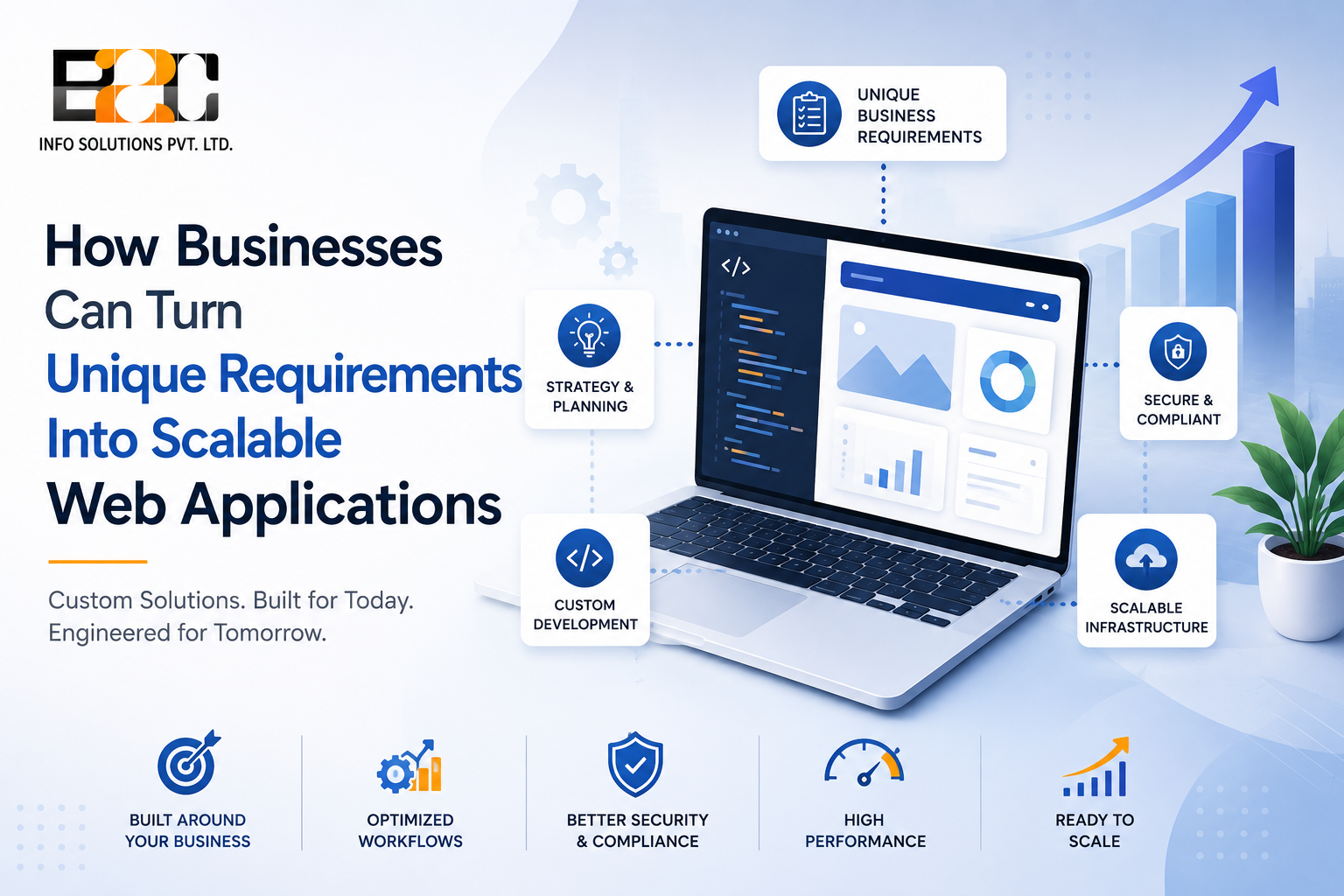
Every business eventually hits a point where off-the-shelf software just doesn't fit anymore, a workflow that needs three extra approval steps, a pricing model no SaaS tool supports, or an integration that simply doesn't exist. Bending a generic platform around these needs usually creates more workarounds than solutions. This is exactly the gap Custom web application development in India is built to close, translating a business's specific operational logic into software designed around it from the ground up, rather than the other way around.
This article walks through how genuinely unique requirements get turned into a working, scalable application, the architectural decisions that determine whether it holds up under growth, and what separates a system built to last from one that needs rebuilding within two years.
Pre-built platforms are designed for the widest possible audience, which means they optimize for common use cases rather than specific ones. A logistics company with a non-standard routing rule, a healthcare provider with a particular compliance workflow, or a manufacturer with a multi-stage inventory process often finds that no combination of settings or plugins fully replicates how the business actually operates.
The result is usually a patchwork of spreadsheets, manual steps, and disconnected tools working around the software rather than through it. Custom development flips that relationship, starting from the business's actual process and building technology to support it directly.
The gap between a business need and working software is bridged through a structured discovery and design process, not by jumping straight into code.
A thorough discovery phase involves documenting actual workflows, edge cases, user roles, and data relationships, often through stakeholder interviews and process mapping rather than a single requirements document written in isolation. Requirements uncovered late in development are consistently more expensive to accommodate than ones identified before design begins.
Architecture decisions made early-whether to use a modular monolith or microservices , how to structure the database, and how tightly different features are coupled- determine how easily the application can handle new features or higher traffic later. A Web app development service in India with genuine architectural experience typically designs for the business's likely trajectory over the next few years, not only its requirements on launch day.
The right stack depends on the specific problem being solved, not current trends. A data-heavy analytics platform, a real-time collaboration tool, and a high-transaction e-commerce system each favour different frameworks, databases, and hosting approaches. Choosing technology based on team familiarity with the business's actual needs, rather than popularity alone, tends to produce more maintainable systems.
Scalability isn't a feature added later; it's a set of decisions baked into the foundation of how an application is built.
Poorly indexed tables, inefficient queries, and rigid schemas often perform fine with a handful of users and fail badly once real traffic arrives. Thoughtful database design, including proper indexing, normalization where appropriate, and caching strategies for frequently accessed data, prevents performance from degrading as usage climbs.
Building the application around well-documented APIs from the start makes it far easier to add a mobile app, connect a third-party service, or integrate with a partner system later, without re-engineering the core platform. This approach also supports the increasingly common need to expose functionality to AI agents and automated tools that interact with software through structured endpoints rather than a visual interface.
Modern cloud platforms allow applications to automatically add computing resources during traffic spikes and scale back down during quieter periods, avoiding both performance bottlenecks and unnecessary infrastructure cost. Working with business web applications that are designed around your unique operational needs allows scalability to be built into the architecture from the beginning. This approach helps businesses handle increasing users, data, and workloads smoothly without relying on costly fixes after growth-related performance issues arise.
Custom applications, particularly those handling payments, healthcare data, or personal information, need security considered as a core design requirement rather than a final checklist item. This includes encrypted data storage, secure authentication, regular dependency updates, and alignment with relevant regulations depending on industry and geography. Retrofitting security into a live application is significantly more disruptive and costly than designing it in from the start.
Decision-makers increasingly search using specific, outcome-focused questions, such as "how to build a scalable app for a growing logistics business" or "custom software vs SaaS for unique workflows," expecting direct, well-supported answers rather than generic marketing pages. Content that answers these exact questions clearly and accurately tends to perform better in both traditional search rankings and AI-generated summaries, since both systems prioritize precision and relevance over broad, keyword-stuffed pages.
AI tools can help frame general options quickly, but evaluating architecture trade-offs, technology choices, and long-term scalability still requires a partner who understands your specific business logic, something a generic AI overview cannot fully substitute for.
If your team regularly builds workarounds, spreadsheets, or manual processes to compensate for gaps in existing software, or if a core part of your workflow simply isn't supported by any available platform, that's a strong signal that a custom solution would likely save more time and cost than continuing to adapt around a generic tool.
Timelines vary widely based on complexity, but a focused minimum viable product for a moderately complex application often takes three to six months, with additional features and refinements following in subsequent phases rather than all at once.
A scalable application can handle significant increases in users, data, or transaction volume without a decline in performance or a complete rebuild, typically achieved through efficient database design, cloud infrastructure that adjusts to demand, and an architecture that isn't overly dependent on any single component.
Not necessarily. Microservices offer flexibility and independent scaling for complex, high-traffic systems, but they also add operational complexity. A well-structured modular monolith is often a more practical and cost-effective choice for many businesses, particularly in earlier growth stages.
Cost depends on complexity, feature scope, and integration requirements, so it varies significantly between a straightforward internal tool and a complex, customer-facing platform. A detailed discovery phase is usually necessary before an accurate estimate can be provided, rather than relying on a generic, one-size-fits-all quote.
Unique business requirements shouldn't force a choice between a rigid, generic platform and a fragile, quickly outgrown custom build. With a structured discovery process, thoughtful architecture, and infrastructure designed for real growth, a custom application can support your operations today while remaining ready for whatever scale comes next.
If your current software is holding your business back instead of supporting it, it's worth exploring what a purpose-built application could do differently. Contact us to discuss how a scalable, custom-built web application could be shaped around your exact requirements.

 4 North
  52 Cornmarket
  C-25, C Block, 91springboard
 #02 - 161 IMM Building