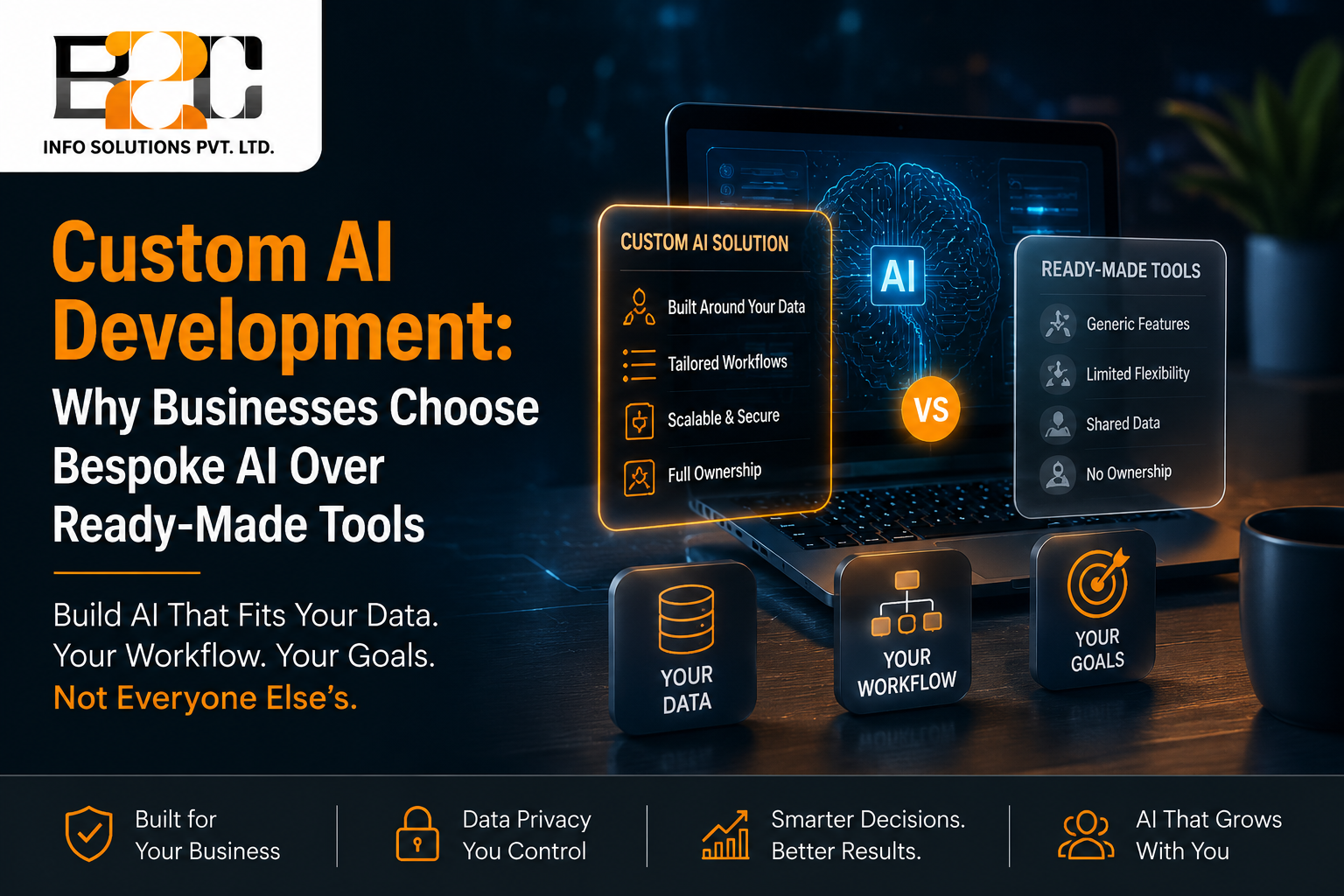
In brief: Custom AI development means building an artificial intelligence system around your own data, workflows, and goals, rather than renting a generic tool that every competitor can also use. Bespoke AI wins when the advantage comes from something only you have, and off the shelf tools win for common tasks where no differentiation is needed. Knowing which is which is the whole decision.
Custom AI development is the practice of designing and building an artificial intelligence solution specifically for one organisation. Instead of adapting your process to fit a vendor's product, the system is shaped around your data, your workflow, and the outcome you care about. That might be a model trained on your historical records, an assistant grounded in your own documents, or an agent that runs a sequence unique to how your business operates. The defining feature is fit: the solution does exactly what you need, and nothing you do not.
Importantly, custom rarely means building a model from nothing. In 2026 most bespoke systems are built on top of powerful foundation models, such as OpenAI GPT (GPT-4.1 and GPT-5), Anthropic Claude, Google Gemini, or open source options like Meta Llama and Mistral, then grounded in your data and wrapped in logic and integrations that are yours alone. The custom part is the data, the workflow, the guardrails, and the fit, not necessarily the underlying model.
This is the core of what a custom AI development company in India delivers: not a template resold to many clients, but a system engineered for one.
Off the shelf AI tools are ready made products you subscribe to and switch on. They cover common, well understood tasks such as generic writing assistance, standard transcription, or broad customer chat, and they are genuinely useful for those. Their strengths are speed and low entry cost: you can be running within a day, with no build required and a predictable monthly fee. For a task that is the same across every company, that is often exactly the right choice.
Their limits appear the moment you need an edge. Because the same tool is available to every competitor, it cannot give you an advantage; it can only keep you level. It works on generic data rather than your own, so its answers are broad rather than sharp. It bends to the vendor's design rather than your workflow. And you own nothing, so the capability, and often your data, sits with the provider. For a commodity task none of that matters. For a core process, all of it does.
Set side by side, the two approaches differ across a handful of factors that decide most cases. The table makes the pattern clear.
|
Factor |
Off the shelf AI |
Custom AI development |
|---|---|---|
|
Source of advantage |
None, everyone runs the same tool |
Your own data, process, and IP |
|
Fit to your workflow |
You adapt to the product |
Built around how you work |
|
Data |
Generic or shared |
Your proprietary data |
|
Ownership |
Subscription, you own nothing |
You own the code, models, and data |
|
Cost shape |
Low upfront, recurring per seat |
Higher upfront, cheaper at scale |
|
Control and change |
Limited to the vendor roadmap |
Yours to extend and adapt |
Bespoke is not always the answer, and a good partner will say so. Choose an off the shelf tool when the task is common and undifferentiated, when speed to switch on matters more than fit, when the volume is too low to justify a build, or when you simply want to test an idea before investing. Using a ready made tool to validate demand, then building custom once the value is proven, is often the smartest sequence. Spending on a bespoke system for a generic task is a waste; recognising that is a sign of good judgement, not a lack of ambition.
Custom development earns its higher cost when the task sits at the heart of your business. The signals are consistent.
The two models have different cost shapes, and comparing only the first month is misleading. An off the shelf tool has a low starting cost but a recurring fee that grows with every user you add, so at scale the total can climb steeply and never stops. A custom build has a higher upfront cost but, once delivered, is an asset you own, with running costs limited to hosting, model usage, and maintenance. Over a multi year horizon, and especially as headcount or volume grows, the owned system frequently becomes the cheaper option as well as the more capable one. The right comparison is total cost over the life of the capability, not the price of getting started.
For businesses serving the US market, the same logic applies through an AI development company in the USA, where a custom build grounded in your data is what separates a genuine advantage from a subscription every rival also holds.
When a specific use case is on the table, a short test cuts through the debate. Ask three questions in order. First, does this task rely on data, documents, or a process that is unique to us? If yes, custom is worth serious consideration. Second, would a competitor using the same generic tool be just as good at this task? If yes, off the shelf is probably fine, because there is no edge to protect. Third, will the volume or sensitivity of this task grow? If yes, the ownership and control of a custom build become more valuable over time.
Consider a practical illustration. A company wants to speed up customer support. For answering broad, generic questions, a ready made assistant may be perfectly adequate and quick to deploy. But if the support quality depends on the company's own product manuals, past tickets, and policies, a custom assistant grounded in that material will resolve far more cases correctly, and it improves as the company's data grows. The same business might sensibly use an off the shelf tool for generic drafting while investing in a custom system for the support experience that actually differentiates it. The lesson is that the choice is rarely all or nothing; it is made task by task, guided by where the real advantage lies.
It is building an AI system specifically for your organisation, shaped around your data, workflow, and goals, so it fits exactly and belongs to you. It usually builds on a foundation model rather than training one from scratch.
It costs more upfront, but you own the result and avoid recurring per seat fees. Over time, and at scale, a custom system is often cheaper as well as more capable, because ownership replaces a subscription that only grows.
For common, undifferentiated tasks, low volumes, or quick validation of an idea. If the task gives no competitive advantage, a ready made tool is the sensible, economical choice.
Usually not. Most custom systems build on a hosted foundation model and add your data, workflow, and guardrails. Training a model from scratch is reserved for rare, highly specialised needs.
Yes, and it is often the wisest path. Using a ready made tool to prove that a use case delivers value, then commissioning a custom build once the return is clear, keeps early risk low while still letting you own the capability where it counts. The initial tool effectively funds the business case for the bespoke system that follows.
Custom AI development wins when your advantage comes from your own data, workflow, and control, while off the shelf tools serve common tasks where no edge is needed. The decision is not about ambition but about fit, so match the approach to the task and compare cost over the full life of the capability. To work out which of your use cases deserve a bespoke build, the team at B2C Info Solutions can help you separate the commodity tasks from the ones worth owning.
About the Author
Jitendra Tomar (JS Tomar) is the Global Business Head at B2C Info Solutions, a premium digital technology company that has delivered more than 1000 web and mobile projects worldwide. With a deep background in strategic formulation and product engineering, he specializes in helping businesses leverage AI, cloud, and experience design to build disruptive software solutions.
Based in Noida, JS is dedicated to nurturing a culture of excellence and delivering high-value digital transformations for clients across North America, Europe, and the Middle East.

 4 North
  52 Cornmarket
  C-25, C Block, 91springboard
 #02 - 161 IMM Building