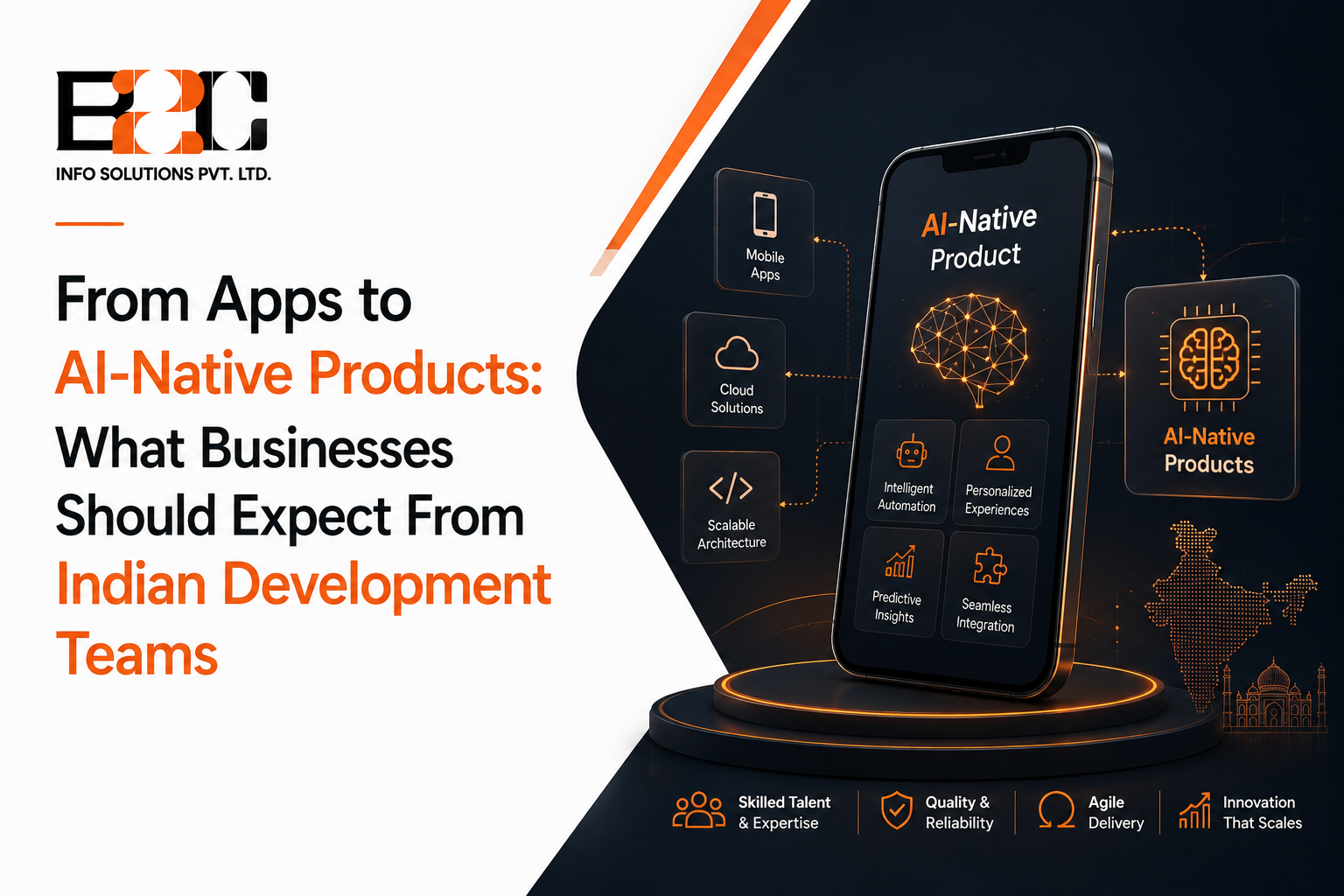
For decades, businesses looking to build software have turned to India partly because of its large and established pool of engineering talent, along with cost efficiency and a mature delivery ecosystem. That reason still holds, but the nature of the work has changed. A mobile app development partner in India today is expected to do far more than write clean code and hit release dates. More clients are exploring ways to build intelligence into the product itself, not added later as an afterthought, and that shift is reshaping how Indian teams scope, staff, and deliver projects.
One common model of outsourced development was largely transactional. A business would hand over a specification, and the vendor would build to it, often with limited input on whether the specification itself made sense. Over the past few years, this has shifted toward a product partnership model, where the development team is expected to question assumptions, suggest simpler architectures, and flag when a requested feature will not scale.
This shift matters because software built without accounting for changing requirements can become harder and more expensive to adapt over time. Requirements change, user behaviour shifts, and a product that cannot absorb that change without a rebuild becomes costly to maintain. Teams that think about the product's full lifecycle, not just the initial release, can reduce avoidable rework later.
Part of this change has come from clients themselves. Founders and product leads now arrive with a much clearer sense of what good software looks like, having used well-built consumer apps for years. That familiarity raises the baseline expectation for polish, speed, and reliability, even on a first release, which in turn pushes development teams to plan more carefully before writing code rather than iterating endlessly after launch.
Artificial intelligence has accelerated this shift rather than caused it. Once teams started building recommendation systems, chat interfaces, and automated workflows into existing apps, it became clear that AI features could not be treated as a separate module bolted onto a finished product. They needed to influence how data was structured, how the backend was designed, and how the app handled uncertainty in the first place. This is the practical difference between an app with an AI feature and a product built to be AI-native from day one.
A common misunderstanding is that adding AI to a product means inserting a chatbot widget or a summarisation button somewhere in the interface. In practice, an AI-native approach affects decisions made much earlier, including what data the app collects, how that data is stored and labelled, and which parts of the user journey can genuinely benefit from automation versus which parts still need a human decision.
A retail app that recommends products well, for example, depends on clean transaction data, a properly designed event pipeline, and a model and data pipeline that can be evaluated and updated as buying patterns change. None of that is visible to the end user, but all of it determines whether the recommendation feature actually works or quietly stops being useful within a few months.
This is also why AI-native planning tends to involve product managers and data specialists from the earliest design conversations, rather than bringing in a machine learning engineer only once the interface has already been finalised. Retrofitting missing telemetry or historical data collection after an app is already in production can be expensive and may leave gaps that cannot be recovered retrospectively.
AI-native planning also requires early decisions about consent, data minimisation, retention, access controls, and how user data can be used for personalisation or model improvement. Addressing these questions at the design stage, rather than after launch, tends to make both the product and its data practices easier to defend later.
For many AI applications that rely on existing foundation models, integrating the model is only one part of the work, with substantial effort also going into data, integration, evaluation, and monitoring. A model that performed well in testing can degrade over time if the underlying data patterns shift, a phenomenon commonly known as model drift.
There is also a growing distinction between training a model from scratch and integrating an existing large language model through an API. For many business applications, using an established model with well-designed prompts, retrieval, and guardrails can be faster and less resource-intensive than training a model from scratch, depending on the use case. A capable team should be able to recommend the simpler path when it genuinely fits the use case, rather than defaulting to a more complex build because it looks more impressive on paper.
Few businesses budget for what happens after an AI feature goes live, yet this is often where the real value is won or lost. A capable AI development partner based in India should be able to explain who monitors model performance after launch, what triggers a review, and when the team would update the model, prompts, retrieval sources, or other parts of the AI system. If a vendor cannot answer these questions clearly, it is a sign that the AI component was designed as a demo feature rather than a production system designed for sustained use.
It helps to see the full picture rather than thinking of AI as a single component. A typical AI-native architecture brings together several layers working alongside one another:
None of these layers work well in isolation. A business evaluating a potential partner can use this list as a simple checklist to see how much of the picture the vendor is actually planning for, rather than just the visible interface.
The distinction between adding AI to an app and designing a product around AI is easier to see side by side.
|
AI-Enabled App |
AI-Native Product |
|
AI added to an existing product |
Product designed around AI capabilities from the outset |
|
Existing data architecture reused as is |
Data architecture planned with AI use in mind |
|
AI feature is often isolated |
AI can influence multiple workflows across the product |
|
Limited AI-specific evaluation |
Ongoing evaluation of AI outputs and performance |
|
Typically feature-led |
Typically behaviour and outcome-led |
A team worth hiring should be able to speak plainly about trade-offs rather than defaulting to whichever framework is fastest for them to staff. Native iOS and Android development still matters for performance-heavy apps, while cross-platform frameworks such as Flutter and React Native remain a sensible choice for many business applications where development efficiency and shared code outweigh the need for platform-specific optimisation. The right answer depends on the product, not on the vendor's convenience.
Cloud architecture experience matters just as much, particularly for products expected to scale quickly. A team that has genuinely operated applications under real production load, rather than only deploying them, tends to bring practical experience with caching, database indexing, observability, and cost control that is difficult to gain from deployment alone.
Security and compliance awareness has also become a baseline expectation rather than a bonus. For apps built for the Indian market, this includes familiarity with payment gateways, identity-verification flows, and applicable data-protection requirements, including India's Digital Personal Data Protection framework, where the nature of the data and processing involved makes it relevant. For apps aimed at international users, it includes an understanding of regional privacy regulations that affect how user data can be collected and processed.
The working relationship matters as much as the technical output. Businesses evaluating a mobile application development company in India should look closely at how the team communicates progress, how decisions are documented, and how much visibility the client has into the codebase and infrastructure at every stage. Fixed-scope contracts can work well for narrowly defined projects, while dedicated team or time-and-materials models tend to suit products that are still evolving, since they allow priorities to shift without renegotiating the entire contract.
An app with AI features usually has a specific function, such as a chatbot or search assistant, added to an otherwise conventional product. An AI-native product is designed from the start around AI capabilities, with data flows, model integration, evaluation, and user interactions considered as part of the core architecture, so intelligence is part of how the product works rather than an extra layer on top.
Timelines depend on the complexity of the features, the quality and availability of relevant data, and whether the AI component is being built from scratch or integrated using existing models and APIs. A realistic project plan should account for data preparation and evaluation time separately from the core app development schedule.
In many cases, yes. Launching with a focused, well-built core product and adding intelligent features once there is real usage data can produce better results than trying to build a fully AI-driven product before there are enough users or enough data to make the AI genuinely useful.
Ongoing costs typically include hosting and infrastructure, maintenance and bug fixes, model or API usage, monitoring, evaluation, and, where required, model updates or retraining. Businesses that only budget for the initial build often find these recurring costs come as a surprise later.
The expectations placed on Indian development teams are increasingly extending beyond pure execution toward product judgement and applied AI expertise. Businesses evaluating a partner today should look past portfolio size and pricing sheets and ask harder questions about ownership, data practices, and what happens after launch. If you are planning a new build or want a second opinion on an existing product roadmap, you can contact us to discuss your requirements with a team that works across both mobile engineering and applied AI.

 4 North
  52 Cornmarket
  C-25, C Block, 91springboard
 #02 - 161 IMM Building