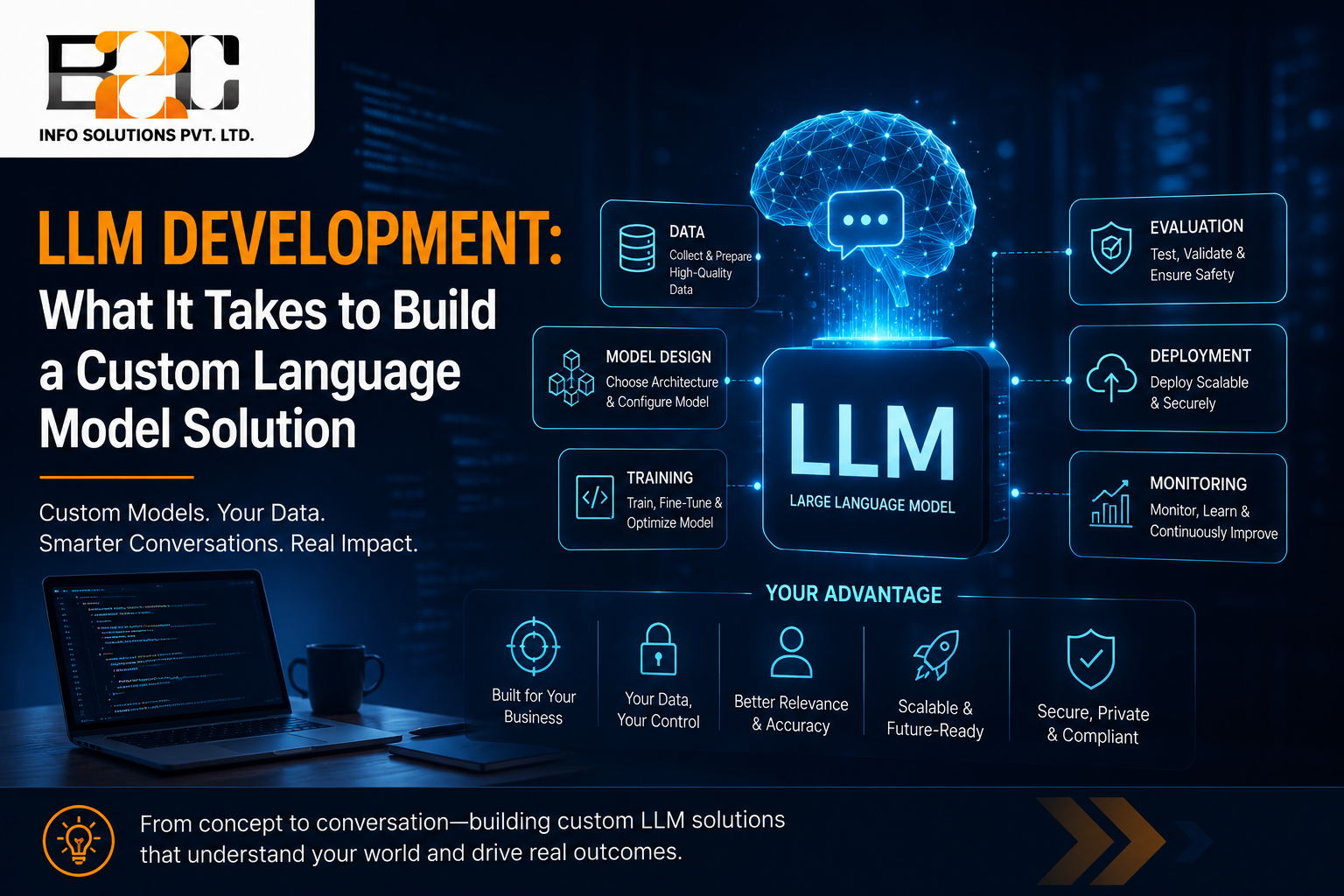
In brief: LLM development is the work of building a language model solution for your business, and it almost never means training a model from scratch. In practice it means choosing the right foundation model, grounding it in your data, shaping its behaviour, and wrapping it in the guardrails and integrations that make it safe and useful. The skill is in the engineering around the model, not in reinventing the model itself.
A large language model, or LLM, is an AI system trained on vast amounts of text that can understand and generate human language. LLM development is the engineering discipline of turning one of these models into a solution that does a specific job for your business, such as an assistant, a document analyser, or a content tool. The common misconception is that this means building a language model from the ground up. It almost never does. Training a foundation model from scratch costs enormous sums and requires resources only a handful of organisations possess.
Instead, LLM development builds on existing foundation models, such as OpenAI GPT (GPT-4.1 and GPT-5), Anthropic Claude, Google Gemini, or open source options like Meta Llama and Mistral, and adapts them to your needs. The real work is in the layers around the model: connecting it to your data, shaping its behaviour, testing its outputs, and integrating it safely into your systems. This is where a capable partner adds value, and where a solution succeeds or fails.
This engineering is a core service of an AI development company in India, and for businesses focused on American markets, an AI development company in the USA delivers the same with local compliance in view.
There is a ladder of techniques for adapting an LLM, from light and fast to heavy and costly. Choosing the right rung for each use case is central to good LLM development.
|
Approach |
What it does |
When to use it |
|---|---|---|
|
Prompt engineering |
Guides the model with careful instructions |
Simple tasks, fastest and cheapest |
|
Retrieval (RAG) |
Grounds answers in your own data |
Assistants that must reflect your content |
|
Fine tuning |
Adjusts the model on your examples |
Consistent tone or domain behaviour at scale |
|
Custom training |
Builds or heavily trains a model |
Rare, highly specialised or private needs |
Most business solutions are built with the first two, prompt engineering and retrieval augmented generation, because they deliver strong results quickly without the cost and complexity of fine tuning. Fine tuning is added when a use case needs a consistent style or specialised behaviour across many interactions, and full custom training is reserved for the rare cases that genuinely require it.
Retrieval augmented generation, or RAG, is the technique that grounds a language model in your own approved data. Instead of answering only from what it learned during training, the model retrieves relevant passages from your documents, policies, or records, and uses them to build its response. The effect is profound: answers become accurate and specific to your business rather than generic, and the risk of the model inventing information drops sharply. For any solution that must reflect your own content, from a support assistant to an internal knowledge tool, RAG is usually essential. It is also more practical than fine tuning for keeping answers current, because you update the underlying data rather than retraining the model.
LLM development powers a growing range of practical solutions, and seeing the common ones helps clarify what is possible.
Part of LLM development is picking the model that fits each use case, and a capable partner stays model agnostic rather than defaulting to one. Hosted commercial models such as OpenAI GPT, Anthropic Claude, and Google Gemini offer strong performance and are fast to work with through an API. Open source models like Meta Llama and Mistral come into their own when you need private or on premise hosting, tighter cost control, or full ownership of the deployment. The choice turns on accuracy for your task, cost at your expected volume, privacy requirements, and whether the model must run inside your own environment. It is common for a single organisation to use different models for different solutions, all managed through one consistent approach.
A dependable LLM project follows a clear sequence, and skipping steps is where risky systems come from.
Language models are powerful but probabilistic, which means they can produce a confident answer that is wrong. In a business setting that is a real risk, so guardrails and evaluation are not optional polish; they are what make an LLM solution trustworthy. Guardrails constrain what the model will discuss, enforce the right tone, and route sensitive or uncertain cases to a person. Evaluation tests the system systematically against real inputs before launch and monitors it afterwards, so quality is measured rather than hoped for. A partner that talks only about the model and not about how its outputs are constrained and checked is missing the part that matters most in production.
Cost depends heavily on the approach. A solution built with prompt engineering and retrieval is far cheaper and faster than one requiring fine tuning, and dramatically cheaper than custom training, which few businesses need. On top of the build, there are running costs: model usage billed per use, hosting, and the retrieval infrastructure. The most economical path for most businesses is to start with prompt engineering and RAG, prove the value on a focused use case, and only invest in fine tuning if a clear need emerges. Starting heavy, with fine tuning or custom training, before proving the simpler approach is a common and expensive mistake. On timing, a focused solution built with prompt engineering and retrieval can often be delivered in a matter of weeks, with most of that time spent preparing the data it will draw on, while fine tuned or deeply integrated systems take longer in proportion to their complexity.
It is building a solution on a large language model for a specific business purpose, such as an assistant or document tool. It usually means adapting an existing foundation model through prompt engineering, retrieval, or fine tuning, not training a model from scratch.
Almost never. Training a foundation model from scratch costs enormous sums and is unnecessary for business use cases. LLM development builds on existing models such as GPT, Claude, Gemini, Llama, or Mistral and adapts them to your needs.
RAG grounds the model in your data at the time of each answer, so responses reflect your current content. Fine tuning adjusts the model itself on your examples for consistent tone or behaviour. Many solutions use RAG first and add fine tuning only when needed.
You ground it in your approved data with RAG, add guardrails that restrict and route responses, and evaluate outputs systematically before and after launch. These measures greatly reduce, though never entirely eliminate, incorrect answers, which is why human oversight remains important for sensitive tasks.
LLM development is about engineering a language model solution around your business, choosing the right foundation model, grounding it in your data with RAG, and adding the guardrails and evaluation that make it safe. It rarely means training a model from scratch, and the smartest path starts light and scales only as needed. To scope an LLM solution for your use case, the team at B2C Info Solutions can help you choose the right approach and build it safely.
About the Author
Jitendra Tomar (JS Tomar) is the Global Business Head at B2C Info Solutions, a premium digital technology company that has delivered more than 1000 web and mobile projects worldwide. With a deep background in strategic formulation and product engineering, he specializes in helping businesses leverage AI, cloud, and experience design to build disruptive software solutions.
Based in Noida, JS is dedicated to nurturing a culture of excellence and delivering high-value digital transformations for clients across North America, Europe, and the Middle East.

 4 North
  52 Cornmarket
  C-25, C Block, 91springboard
 #02 - 161 IMM Building