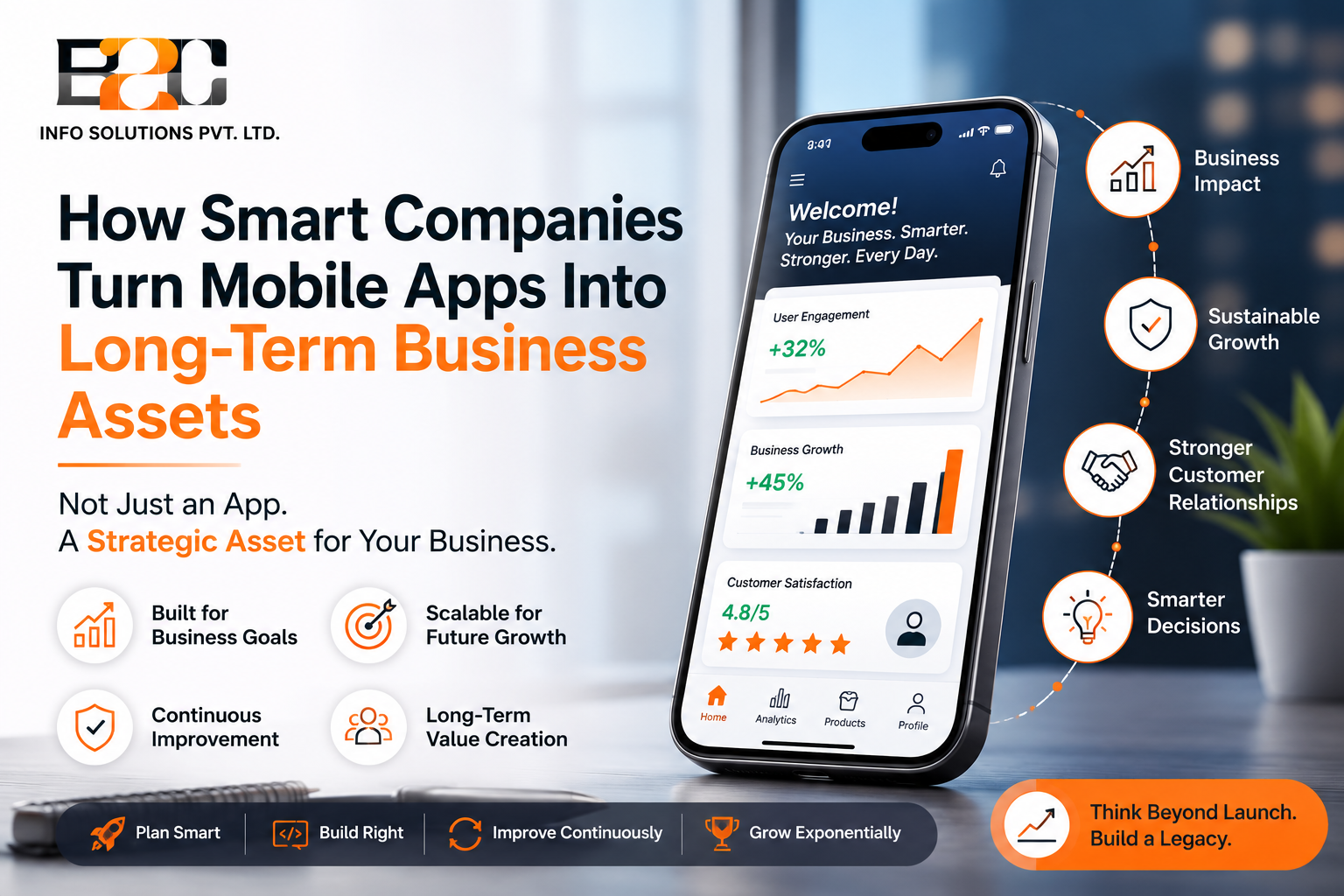
Every year, thousands of mobile apps launch with strong expectations, yet many fail to deliver lasting business value. The problem is rarely the technology itself. More often, businesses treat launch day as the destination instead of the beginning of an ongoing product journey.
Companies that partner with an experienced Mobile App Development Company India understand that successful apps are built through continuous improvement, customer feedback, and measurable business outcomes. Downloads may create early momentum, but long-term growth comes from consistently solving user problems and adapting to changing market expectations.
A common misconception is that a well designed app with strong initial downloads has already succeeded. Download numbers fade quickly if the product does not keep solving real problems for users. Long-term success depends on continuous investment, structured feedback loops, and a willingness to evolve the product as customer expectations shift.
This article explains why treating an app as a one-time project limits its potential, and what businesses can learn from companies that turn their applications into lasting assets. You can also explore how a structured mobile app development approach supports this kind of long-term thinking.
Industry research consistently shows that user retention drops significantly after the first month for many mobile applications, highlighting why continuous product improvement is far more important than a successful launch alone.
Many apps decline in relevance within months of release. The most common reason is a lack of long-term planning. Teams focus heavily on the build phase and allocate little budget or attention to what comes next.
Without a structured feedback strategy, businesses miss early signals about what users actually want. A retail brand, for example, might launch a shopping app with strong initial traction, then watch usage decline because checkout friction was never addressed after launch.
Limited product evolution is another factor. If a business mobile application stops receiving meaningful updates, users gradually shift to competitors offering more relevant features. Markets change, customer expectations rise, and an app that does not adapt starts to feel outdated even if the core functionality still works.
Launching an app should be treated as the beginning of a much longer product journey, not the completion of a project.
The difference between companies that succeed long term and those that stall often comes down to mindset. A project mindset treats the app as a deliverable with a defined end date. A product mindset treats it as an evolving asset tied directly to business outcomes.
Successful organizations continuously evolve their apps using customer feedback, Agile development practices, product analytics, and iterative product roadmaps instead of relying on assumptions made before launch.
Innovation driven by user behavior tends to outperform innovation driven by internal opinion. Companies that maintain long-term product ownership, rather than handing an app off after launch and moving on, are far more likely to see sustained growth. Mobile applications built with this philosophy are treated as strategic business assets rather than technical checkboxes.
A mobile app only creates lasting value when it is built around clear business objectives rather than generic feature lists. Customer retention, revenue generation, operational efficiency, brand loyalty, and competitive differentiation should all shape early product decisions.
This is where working with a partner offering Custom Mobile App Development Services becomes valuable. Rather than applying a one size fits all template, an experienced team maps features directly to measurable business goals. A logistics company, for instance, may prioritize operational efficiency and real-time tracking, while a consumer brand may prioritize engagement and loyalty features.
Digital transformation initiatives succeed when mobile applications are positioned as core business tools rather than standalone products. When an app supports specific outcomes such as reducing support costs or increasing repeat purchases, it becomes far easier to justify continued investment and prove long-term ROI.
For example, a healthcare provider may focus on improving patient engagement through appointment reminders and secure communication, while an e-commerce business may prioritize personalized recommendations and loyalty rewards. Business objectives should always determine feature priorities rather than following industry trends.
Products that remain relevant for years share one habit: continuous improvement. Regular feature updates keep the experience aligned with changing user expectations, while analytics driven product improvements ensure decisions are based on evidence rather than guesswork.
Integrating user feedback into the roadmap allows teams to address friction points before they cause churn. Technology modernization is equally important. Modern analytics platforms such as Firebase Analytics, Google Analytics, and Mixpanel also help businesses understand user behavior, identify friction points, and prioritize improvements based on real customer data rather than assumptions. An app built on outdated frameworks becomes harder to maintain and slower to update, which eventually limits growth.
Security enhancements and performance optimization also play a direct role in retention. Users abandon apps that feel slow, unstable, or unsafe far faster than they abandon apps with minor design imperfections. Businesses that treat improvement as an ongoing discipline, rather than an occasional project, consistently outperform those that only revisit their app when something breaks.
Download counts are often the first metric businesses look at, but they rarely reflect long-term success. Meaningful indicators include user engagement, active user counts, customer lifetime value, retention rates, revenue contribution, and customer satisfaction.
Businesses that adopt a product mindset typically monitor a balanced set of metrics, including monthly active users, customer lifetime value, retention rate, average session duration, feature adoption, and customer satisfaction. Together, these indicators provide a much clearer picture of long-term business performance than download numbers alone.
A fitness app with a million downloads but low weekly engagement is performing worse than a niche app with fifty thousand highly active users who renew subscriptions consistently. Businesses that track engagement and retention alongside revenue contribution get a far clearer picture of whether the product is actually driving growth.
Customer satisfaction, measured through reviews, support tickets, and direct feedback, offers additional insight that download numbers cannot provide. When these metrics are reviewed together, they reveal whether an app is genuinely contributing to business growth or simply generating short-term attention.
Selecting the right development partner has a direct impact on whether an app becomes a long-term asset or a short-lived project. Strategic consultation and thorough product discovery at the start help align technical decisions with business goals from day one.
An experienced development partner also helps establish a long-term product roadmap, ensuring future feature releases, platform updates, performance improvements, and security enhancements remain aligned with evolving business objectives.
Scalable architecture and future-ready technology choices prevent costly rebuilds as the business grows. Equally important is what happens after launch. Ongoing maintenance, structured product roadmap planning, and continuous optimization determine whether an app keeps improving or slowly stagnates.
Partners offering genuine Enterprise Mobile App Development experience bring the technical depth and long-term perspective needed for complex, scaling organizations. The right partner functions less like a vendor and more like an extension of the product team, invested in the app's performance well beyond the launch date.
Companies that build lasting value from their mobile applications tend to follow a consistent set of principles. They think long term The most successful mobile applications are rarely the ones with the biggest launch campaigns. They are the ones that continue solving customer problems year after year through continuous innovation, thoughtful product decisions, and ongoing investment. instead of focusing only on launch. They build around real customer needs rather than internal assumptions. They invest in continuous improvement instead of treating the app as finished software. They measure business outcomes rather than vanity metrics. And they partner with experienced development experts who understand both technology and business strategy.
If your business is planning to build a scalable mobile application that continues creating value long after launch, If your business is planning to build a scalable mobile application that continues creating measurable business value long after launch, the team at B2C Info Solutions can help you develop a product strategy focused on growth, customer retention, and long-term success.
An app represents an ongoing relationship with customers, not a one-time transaction. Markets, technology, and user expectations change constantly, and an app that stops evolving quickly loses relevance. Businesses that treat their app as a long-term asset invest in regular updates, feedback loops, and performance improvements, which protects the original investment and continues generating returns. This approach also supports better decision making, since teams track meaningful metrics like retention and lifetime value instead of focusing only on launch day downloads.
There is no fixed schedule that works for every business, but most successful apps receive meaningful updates every few weeks to a few months. Minor bug fixes and performance improvements often happen more frequently, while larger feature releases follow a planned product roadmap. The right cadence depends on user feedback, competitive pressure, and platform requirements from Apple and Google. What matters most is consistency. Apps that go long periods without updates tend to lose user trust and gradually decline in engagement.
A successful business app solves a real problem consistently and reliably. Strong performance, intuitive design, and security matter, but they support the core function rather than replace it. Successful apps are built around clear business objectives, whether that is customer retention, revenue growth, or operational efficiency, and they evolve based on actual user behavior. Long-term success also depends on measurement. Businesses that track engagement, retention, and customer satisfaction alongside revenue are better positioned to keep improving the product over time.

 4 North
  52 Cornmarket
  C-25, C Block, 91springboard
 #02 - 161 IMM Building