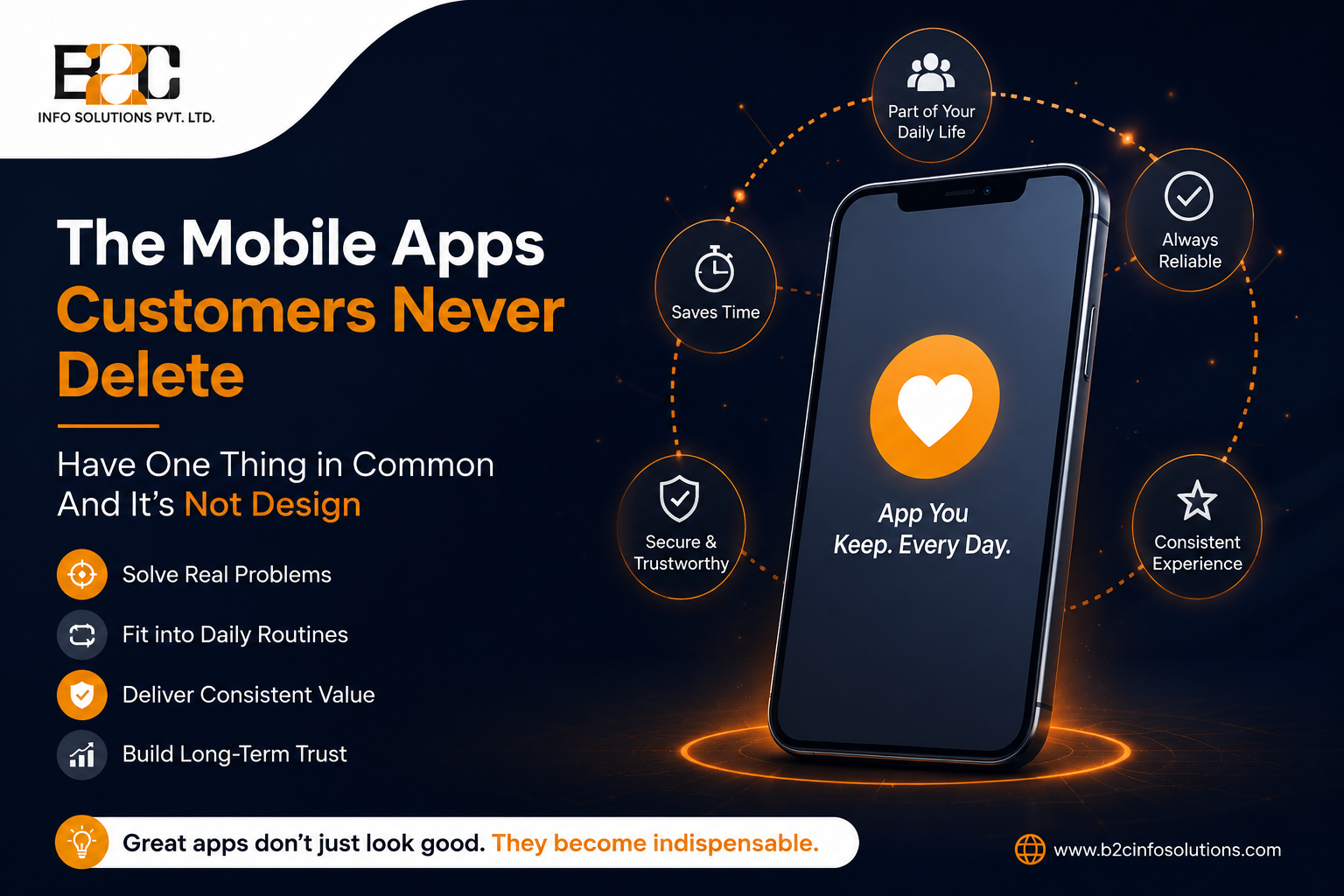
The mobile app market has never been more crowded, and competition for user attention keeps intensifying. A polished launch and strong first week downloads no longer guarantee success. Businesses working with an experienced Mobile App Development Company USA know that acquiring users is only half the challenge; retaining them is where real value gets created.
There is an important difference between getting someone to download an app and getting them to keep using it months later. Many companies focus heavily on acquisition metrics while underestimating what actually keeps customers engaged over time. Appearance matters, but it is rarely the deciding factor in whether an app survives on someone's phone.
Marketing budgets can drive a strong first week of installs, but they cannot force someone to open an app for a second or third time. That decision is shaped entirely by the experience itself, which is why businesses that focus only on acquisition often see disappointing long-term results despite an impressive launch.
This article explores what separates apps people delete within days from apps people rely on for years, and how thoughfull mobile app development supports that outcome.
Users today have little patience for friction. Poor onboarding is one of the fastest ways to lose someone, especially when a first-time user cannot understand the app's value within the first few screens. Slow performance and confusing navigation compound the problem, pushing users toward faster, simpler alternatives.
A food delivery app that takes too long to load during a hungry customer's ordering window will likely be deleted and replaced within minutes. Beyond onboarding and speed, many apps fail because they stop delivering ongoing value. A budgeting app that is useful once but never adapts to a user's changing financial habits eventually gets ignored.
First impressions still matter, but they are no longer enough on their own. Retention depends on what happens after the first session, not just how polished that first session looks.
Industry comparisons make this pattern clear. Two competing apps in the same category can launch within weeks of each other, yet one retains a steady base of active users while the other sees a sharp drop off after the first month. The difference almost always traces back to how well each app handled the early user experience, not which one looked more polished in the app store screenshots.
The apps people keep for years almost always solve a recurring problem. Whether it is managing money, tracking fitness, communicating with colleagues, or ordering groceries, these apps become part of a daily or weekly routine rather than a one-time solution.
Habit formation plays a major role here. When an app becomes the default way someone handles a specific task, switching costs rise naturally. A messaging app used daily by an entire friend group is far harder to replace than a niche app used once a month.
User psychology also explains why usefulness consistently outperforms visual appeal. People tolerate imperfect design if the app reliably delivers value. They abandon beautifully designed apps that fail to solve a real problem. Businesses that understand this prioritize function first and treat design as an enhancement rather than the core strategy.
Certain features consistently separate apps that get deleted from apps that stay installed. Personalization helps users feel like the app understands their specific needs rather than offering a generic experience. Speed and reliability are non-negotiable, since even minor lags create frustration over repeated use.
Meaningful notifications, rather than constant promotional noise, keep users engaged without pushing them toward the uninstall button. Offline functionality matters in categories like travel, productivity, or navigation, where connectivity cannot always be guaranteed.
Working with a team that offers genuine Custom Mobile Apps Developers ensures these features are built around actual user needs rather than added as an afterthought. Continuous feature improvements and a simple, intuitive user journey complete the picture, keeping the product easy to use even as new functionality gets added over time.
Performance is not just a technical concern, it is a trust issue. Fast loading times signal reliability, while frequent crashes or slow responses quickly erode user confidence. Security and privacy protections matter even more today, as users have grown more cautious about how their data is handled.
Stability across devices is equally important. An app that performs well on one phone model but poorly on another creates inconsistent experiences that damage credibility. Regular performance optimization and thoughtful app updates show users that a business is actively maintaining the product rather than letting it stagnate.
Customer confidence builds gradually through consistent, dependable performance. Once that trust is established, users become far less likely to switch to a competing app, even one with a more attractive interface.
Great apps balance business-first strategy with customer-first thinking. A clear product roadmap ensures that every feature decision supports long-term scalability rather than short-term novelty. Without this alignment, teams often build features that look impressive but do little to move the business forward.
Key performance indicators should extend well beyond downloads. Revenue contribution, user engagement, and customer lifetime value provide a much more accurate picture of whether an app is succeeding. A subscription-based service, for example, should track renewal rates and engagement frequency far more closely than initial install numbers.
Businesses that align product decisions with measurable goals are better equipped to justify continued investment and demonstrate real return over time.
Choosing the right development partner has a direct impact on whether an app earns long-term loyalty. A strong partner starts by understanding business objectives, not just technical requirements, and applies genuine UX thinking rather than default templates.
Scalable architecture and future-ready development practices prevent the app from becoming outdated as the business grows. Ongoing maintenance and continuous improvements are just as important as the initial build, since user expectations keep shifting after launch.
Partners with real Enterprise Mobile App Development experience bring the structure needed to support complex, growing organizations over many years, not just through a single release cycle. This kind of long-term collaboration tends to produce apps that customers genuinely rely on.
The apps customers keep for years share a consistent pattern. Value consistently beats appearance. Performance directly shapes trust. Long-term thinking outperforms a narrow focus on launch day. Sustained engagement requires ongoing investment, not a one-time build. And strategic development partnerships make all of this achievable at scale.
If you're planning to build a mobile application that delivers lasting business value rather than short-term downloads, connect with the experts at B2C Info Solutions. Their team can help you get started with a strategy built around long-term retention and growth.
Customers typically uninstall apps due to poor onboarding, slow performance, confusing navigation, or a lack of ongoing value. If an app does not clearly demonstrate its usefulness within the first few interactions, users move on quickly to alternatives. Apps that fail to update regularly or that accumulate bugs over time also see higher uninstall rates. In many cases, uninstalls happen not because the app was broken, but because it simply stopped being useful or relevant to the user's daily routine.
Design plays an important supporting role, but functionality consistently matters more for long-term retention. Users tolerate imperfect visual design far more readily than they tolerate an app that fails to solve their problem reliably. The most successful apps combine clean, intuitive design with dependable core functionality, but when trade offs are necessary, prioritizing performance and usefulness typically produces better retention outcomes than prioritizing aesthetics alone.
Improving retention starts with understanding why users leave, which requires tracking engagement data and gathering direct feedback. Businesses should focus on fast performance, meaningful personalization, and consistent value delivery rather than one-time feature releases. Regular updates, thoughtful notifications, and reliable security also build long-term trust. Setting clear KPIs around engagement and customer lifetime value, rather than downloads alone, helps businesses make better decisions about where to invest in ongoing product improvement.

 4 North
  52 Cornmarket
  C-25, C Block, 91springboard
 #02 - 161 IMM Building