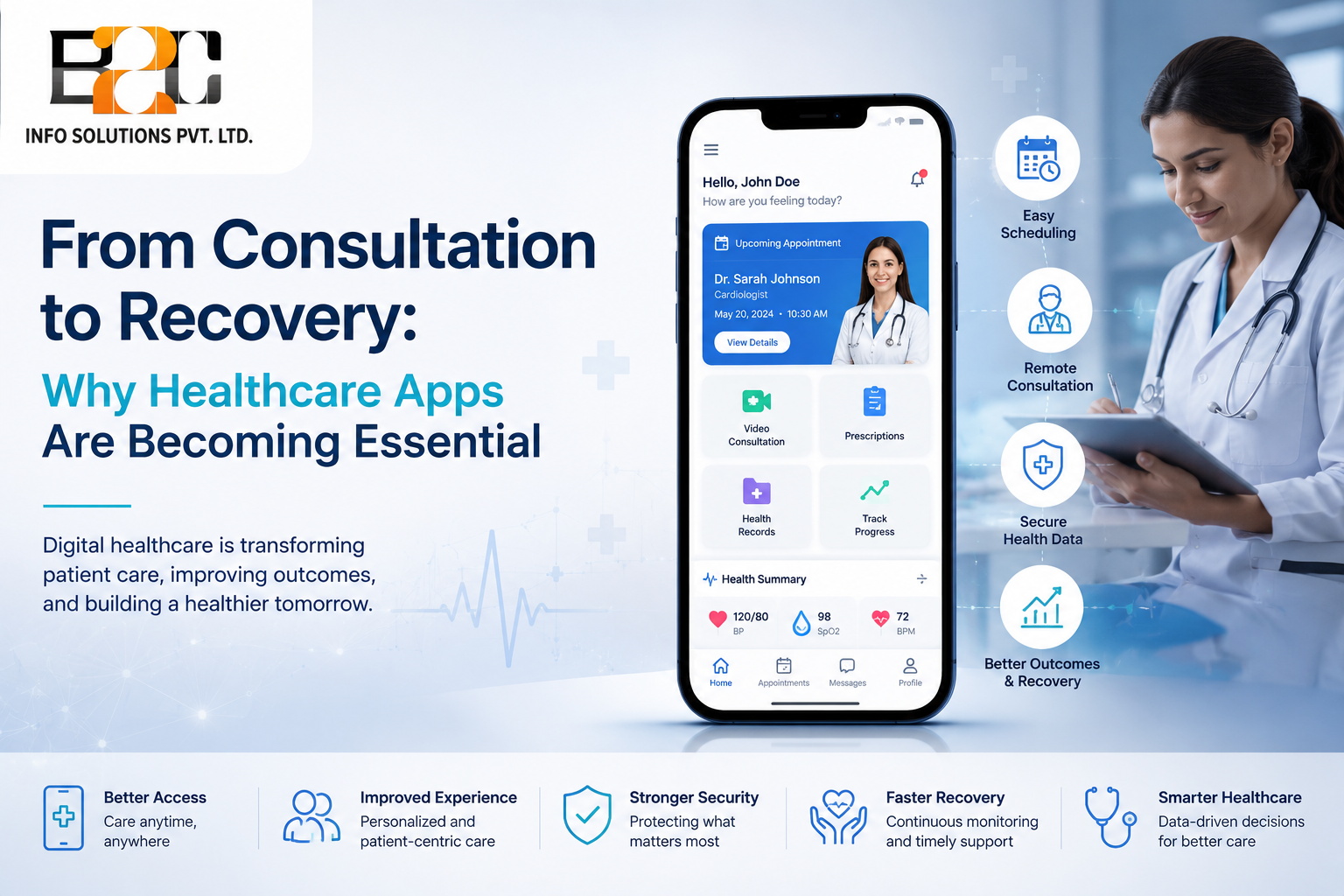
Healthcare no longer begins and ends inside a hospital building. Patients now expect care that follows them home, into their workplaces, and through every stage of recovery. This shift in expectations has pushed hospitals, clinics, and healthcare startups to rethink how they deliver services, and a trusted Healthcare App Development Company has become central to that transformation. Modern patients want instant appointment booking, virtual consultations, and real-time access to their medical records, and they want it all from a device they already carry everywhere. Digital healthcare is no longer a convenience; it is an expectation. Organizations that fail to meet this expectation risk losing patients to competitors who have already embraced mobile-first care. This article explores why healthcare applications have become indispensable across the entire patient journey, from the first consultation to full recovery, and why choosing the right technology partner matters more than ever.
Healthcare delivery has moved through several stages, from paper records to electronic systems and now to fully connected digital ecosystems. Each stage has brought greater efficiency, but the current wave of mobile and cloud technology represents the most significant leap yet.
Smartphones have become the primary touchpoint between patients and providers. A mobile-first approach allows healthcare organizations to reach patients wherever they are, reducing missed appointments and improving continuity of care.
Telemedicine has moved from a niche offering to a mainstream expectation. Video consultations reduce travel time, expand access for rural patients, and allow providers to manage larger patient volumes without compromising quality.
Modern healthcare depends on interoperability between apps, wearables, hospital systems, and pharmacies. A connected ecosystem ensures that data flows securely between every touchpoint in the care journey.
Remote monitoring and virtual check-ins allow providers to track patient progress without requiring in-person visits for every follow-up, which is particularly valuable for chronic disease management.
Integration with Electronic Health Records ensures that patient history, prescriptions, and test results are available instantly to authorized providers, reducing duplication and diagnostic errors.
Patients increasingly judge a provider's quality of care by the quality of their digital experience. A clean, intuitive app often shapes patient trust as much as clinical outcomes do.
Healthcare apps remove geographic and physical barriers, giving patients in remote areas the same access to specialists as those in major cities.
Digital intake forms, instant scheduling, and virtual waiting rooms significantly reduce the time between symptom onset and clinical consultation.
Patient engagement apps keep individuals actively involved in their own care through reminders, educational content, and progress tracking.
Wearables and connected devices feed real-time vitals into healthcare apps, allowing providers to intervene early when readings fall outside safe ranges.
Automated medication reminders reduce missed doses, a common contributor to poor outcomes in chronic conditions such as diabetes and hypertension.
Secure in-app messaging allows patients to ask follow-up questions without scheduling a full appointment, improving satisfaction on both sides.
For example, a clinic using automated post-discharge check-ins through a mobile app can identify complications earlier than one relying solely on phone calls, directly improving recovery outcomes.
Each of these features matters because healthcare data is uniquely sensitive, and any gap in functionality or security can directly affect patient safety and organizational trust.
Patients gain faster access to care, clearer communication with providers, and greater control over their own health information.
Providers benefit from streamlined workflows, fewer administrative burdens, and better visibility into patient histories, which supports more accurate diagnoses.
Organizations see improved operational efficiency, reduced costs from fewer missed appointments, and stronger patient retention through better experiences.
For example, a mid-sized clinic that introduced automated scheduling and reminders reduced no-show rates significantly while freeing staff to focus on higher-value patient interactions. This kind of operational efficiency, combined with better clinical workflows, is why healthcare software solutions are increasingly viewed as a business investment rather than a technology expense.
Building a healthcare application is fundamentally different from building a typical consumer app. Patient safety, regulatory compliance, and data security are non-negotiable, which makes the choice of development partner one of the most important decisions a healthcare organization will make.
A partner with genuine healthcare experience understands clinical workflows, patient behavior, and provider constraints in ways a generalist team cannot.
Regulatory frameworks such as HIPAA require specialized knowledge that must be built into the application from day one, not added afterward.
A strong partner helps define the right feature set for your specific patient population rather than defaulting to a generic template.
Healthcare users span all age groups and technical comfort levels, so thoughtful design directly impacts adoption and satisfaction.
Security cannot be an afterthought. It must be embedded into architecture, testing, and deployment from the earliest stages of custom healthcare app development.
As patient volumes grow, the application must scale without performance issues, and ongoing support ensures the platform evolves alongside regulations and patient needs. This is why many hospitals and healthcare startups partner with an experienced healthcare mobile app development team rather than attempting to manage complex, compliance-heavy builds internally.
Patient data is highly sensitive, and compliance requirements vary by region and specialty. Partners who build encryption, access controls, and compliance-first processes into the initial architecture avoid costly violations later.
Many healthcare organizations rely on older systems, and EHR integration can be complex due to inconsistent data standards. Well-documented APIs, middleware, and standards such as HL7 or FHIR simplify integration without disrupting existing operations.
Even well-built apps fail without adoption. Intuitive design, in-app guidance, and staff training significantly improve uptake among patients and providers alike.
Slow apps frustrate users during urgent situations, and sudden spikes, such as during public health events, require cloud infrastructure that scales elastically. Regular performance testing under real-world conditions helps maintain reliability.
Artificial Intelligence and machine learning are increasingly used to support predictive healthcare, helping providers identify risk factors before symptoms fully develop. Wearables and IoT devices continue to expand remote diagnostics capabilities, feeding continuous data streams into care platforms. Voice assistants are simplifying documentation and patient interaction, while advanced data analytics enable more personalized healthcare recommendations based on individual patient patterns. Together, these technologies are pushing healthcare applications toward more proactive, rather than reactive, models of care. Organizations investing in these capabilities now are positioning themselves ahead of competitors who delay adoption of connected healthcare tools.
Healthcare has permanently shifted toward digital-first experiences, and applications now play a central role at every stage of the patient journey, from the first consultation to full recovery. Organizations that invest in secure, scalable, and thoughtfully designed platforms are better positioned to improve patient outcomes while strengthening operational efficiency. Choosing the right healthcare technology partner ensures these digital healthcare solutions are built to last, rather than requiring costly rework later. As patient expectations continue to rise, the organizations that act now will define the standard for care in the years ahead. If your organization is ready to build a secure, patient-centered healthcare application, contact B2C Info Solutions to start the conversation.
Why are healthcare apps important for modern medical practices? Healthcare apps improve accessibility, streamline communication, and support better clinical outcomes by keeping patients engaged throughout their care journey, from consultation through recovery.
What features should a healthcare application include? Successful healthcare applications typically include appointment booking, secure messaging, video consultation, medical records access, and strong security measures such as HIPAA-compliant encryption.
How do I choose the right Healthcare App Development Company? Look for a partner with proven healthcare industry experience, strong compliance knowledge, security-first development practices, and a track record of building scalable, patient-focused applications.
Author Bio
JS Tomar is the Global Business Head at B2C Info Solutions, a premium digital technology company that has delivered over 1000+ web and mobile projects worldwide. With a deep background in strategic formulation and product engineering, he specializes in helping businesses leverage AI, cloud, and experience design to build disruptive software solutions. Based in Noida, JS is dedicated to nurturing a culture of excellence and delivering high-value digital transformations for clients across North America, Europe, and the Middle East.

 4 North
  52 Cornmarket
  C-25, C Block, 91springboard
 #02 - 161 IMM Building