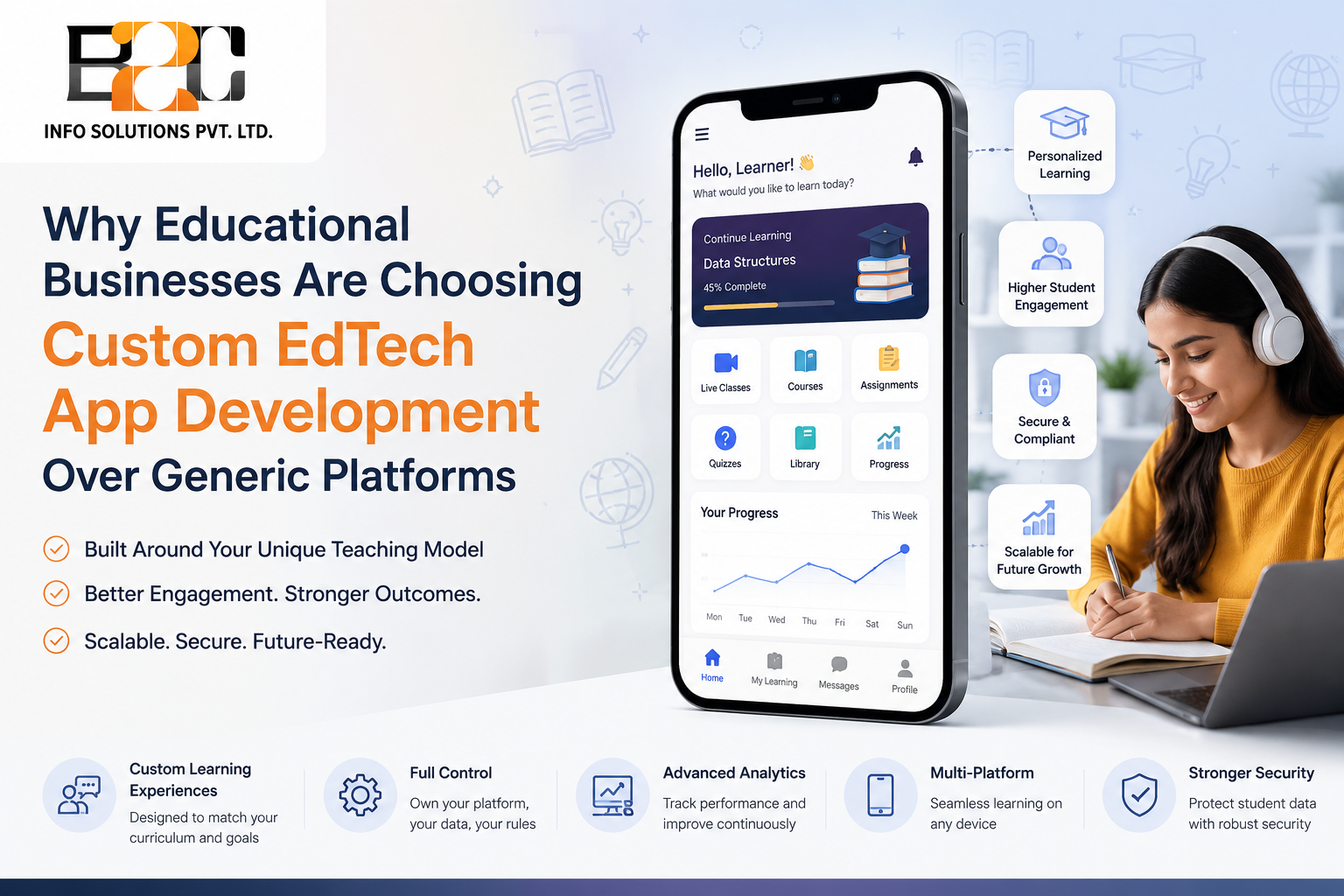
Digital education has evolved faster in the last few years than in the previous two decades combined. Learners now expect on-demand video lessons, live virtual classrooms, and personalized study paths, all delivered through a single app. As this shift accelerates, many institutions are discovering that generic platforms simply cannot keep pace, which is why more schools, universities, and training providers are turning to a dedicated EdTech App Development Company to build something built specifically around their learners. Off-the-shelf tools were useful in the early days of online learning, but they were never designed to support the scale, branding, and personalization that growing education businesses now require. This article explains why educational organizations are moving away from generic platforms and investing in custom applications built for long-term growth, and what institutions should know before choosing a technology partner.
Education has shifted from static content delivery to interactive, on-demand learning experiences. Learners now expect the same convenience from their coursework that they get from consumer apps.
Most students and professionals access learning content primarily through smartphones. An education platform that is not built mobile-first risks losing learners before they even complete a first lesson.
Learners expect content that adapts to their pace, goals, and prior knowledge, rather than a one-size-fits-all curriculum.
Institutions increasingly combine in-person instruction with online modules, requiring platforms that support both seamlessly.
As more institutions and coaching centers launch digital offerings, differentiation through experience and branding has become essential for survival.
Generic content delivery often leads to high dropout rates. Interactive features and progress tracking are now necessary to keep learners engaged.
Education is increasingly technology-led, with institutions relying on data, automation, and digital tools to improve both teaching quality and operational efficiency.
Generic platforms offer fixed templates and workflows that rarely match the specific needs of an institution's curriculum or teaching style.
Most off-the-shelf tools look and feel the same across every client, making it difficult for an institution to stand out or build a distinct learning identity.
Many ready-made platforms limit how much an institution can customize logos, colors, and overall design, weakening brand recognition.
As student numbers grow, generic platforms often struggle with performance, particularly during live sessions or exam periods with high concurrent usage.
Shared infrastructure across multiple clients can lead to slowdowns during peak usage, directly affecting the learning experience.
Off-the-shelf tools often integrate poorly with existing student information systems, payment gateways, or internal reporting tools.
Institutions relying on third-party platforms have limited control over feature roadmaps, pricing changes, or sudden discontinuation of services. A vendor's shifting priorities can directly disrupt an institution's growth plans.
For example, a coaching institute that scaled from a few hundred to several thousand students on a generic platform found itself unable to add custom assessment tools without waiting on the vendor's release schedule, ultimately losing time and competitive edge.
Custom platforms support adaptive learning, individual learning paths, and AI-powered recommendations that adjust content based on real student performance, helping learners progress at a pace that suits their own strengths and gaps.
Custom workflows and modular architecture allow institutions to add new features, such as certification modules or corporate training tracks, without vendor delays. This means an institution can respond to new market demands, such as launching a professional certificate program, within weeks rather than waiting for a third-party roadmap.
Better branding, improved user engagement, and higher retention naturally follow when a platform is designed specifically around an institution's learners rather than a generic audience. This flexibility also supports long-term business scalability as student numbers and course offerings grow, allowing institutions to expand into new markets or program formats without rebuilding their core technology.
Each of these features contributes directly to better learning outcomes by reducing friction, increasing engagement, and giving institutions the data they need to improve continuously.
Choosing the right technology partner is one of the most consequential decisions an educational business will make, since the platform becomes the primary interface between the institution and its learners.
A strong partner helps define the right features for a specific learner base rather than applying a generic template.
Thoughtful UX design keeps learners engaged and reduces dropout rates, particularly for younger or first-time online learners.
A well-built platform can handle growth from hundreds to hundreds of thousands of learners without performance degradation.
Student data protection must be built into the architecture from day one, not added as an afterthought.
Ongoing updates ensure the platform evolves alongside new teaching methods, compliance requirements, and learner expectations. This is why institutions increasingly invest in custom EdTech apps rather than settling for generic tools that cannot adapt over time.
Student information is highly sensitive, often including academic records, payment details, and behavioral data. Institutions should work with partners who implement strong encryption, role-based access controls, and regular security audits from the outset.
Education platforms must often meet regional data protection standards, and requirements can vary significantly between K-12, higher education, and corporate training contexts. Building compliance into the architecture from the beginning avoids costly rework later.
Even well-designed platforms fail without adoption. Intuitive design, accessibility features for learners with disabilities, and structured onboarding support improve usage among both students and instructors.
Regular updates keep the platform secure and compatible with new devices and operating systems, preventing performance issues over time and reducing the risk of unplanned downtime.
Institutions should plan infrastructure that can handle seasonal spikes, such as exam periods or new academic term enrollments, without downtime, ensuring a consistent experience even during the busiest periods of the academic calendar.
Artificial Intelligence continues to reshape education through adaptive learning systems that personalize content based on individual performance data. Learning analytics help institutions identify at-risk students earlier, while AR and VR are creating immersive training experiences for technical and vocational education. Gamification and microlearning are improving engagement by breaking content into shorter, more digestible formats. Cloud-based education infrastructure and predictive analytics are further enabling institutions to scale efficiently while continuously refining the learning experience based on real usage data.
Educational businesses are increasingly recognizing that generic platforms cannot support long-term growth, deeper personalization, or a distinct brand identity. Custom applications, by contrast, create a sustainable competitive advantage by adapting to institutional needs rather than forcing institutions to adapt to fixed templates. Investing in the right digital learning solutions today positions institutions to scale confidently as learner expectations continue to rise. Educational organizations ready to move beyond the limitations of generic tools should contact B2C Info Solutions to explore what a purpose-built platform can achieve.
Why are educational businesses choosing custom EdTech applications over generic platforms? Custom applications offer greater personalization, stronger branding, and the flexibility to scale without vendor limitations, which generic platforms typically cannot provide.
What are the main benefits of custom EdTech app development? Key benefits include adaptive learning paths, modular architecture for easy feature expansion, improved student engagement, and long-term scalability aligned with institutional growth.
How do I choose the right EdTech App Development Company? Look for a partner with proven education industry experience, strong data security practices, thoughtful UX design capabilities, and a track record of building scalable learning platforms.
Author Bio
JS Tomar is the Global Business Head at B2C Info Solutions, a premium digital technology company that has delivered over 1000+ web and mobile projects worldwide. With a deep background in strategic formulation and product engineering, he specializes in helping businesses leverage AI, cloud, and experience design to build disruptive software solutions. Based in Noida, JS is dedicated to nurturing a culture of excellence and delivering high-value digital transformations for clients across North America, Europe, and the Middle East.

 4 North
  52 Cornmarket
  C-25, C Block, 91springboard
 #02 - 161 IMM Building