Table of Contents
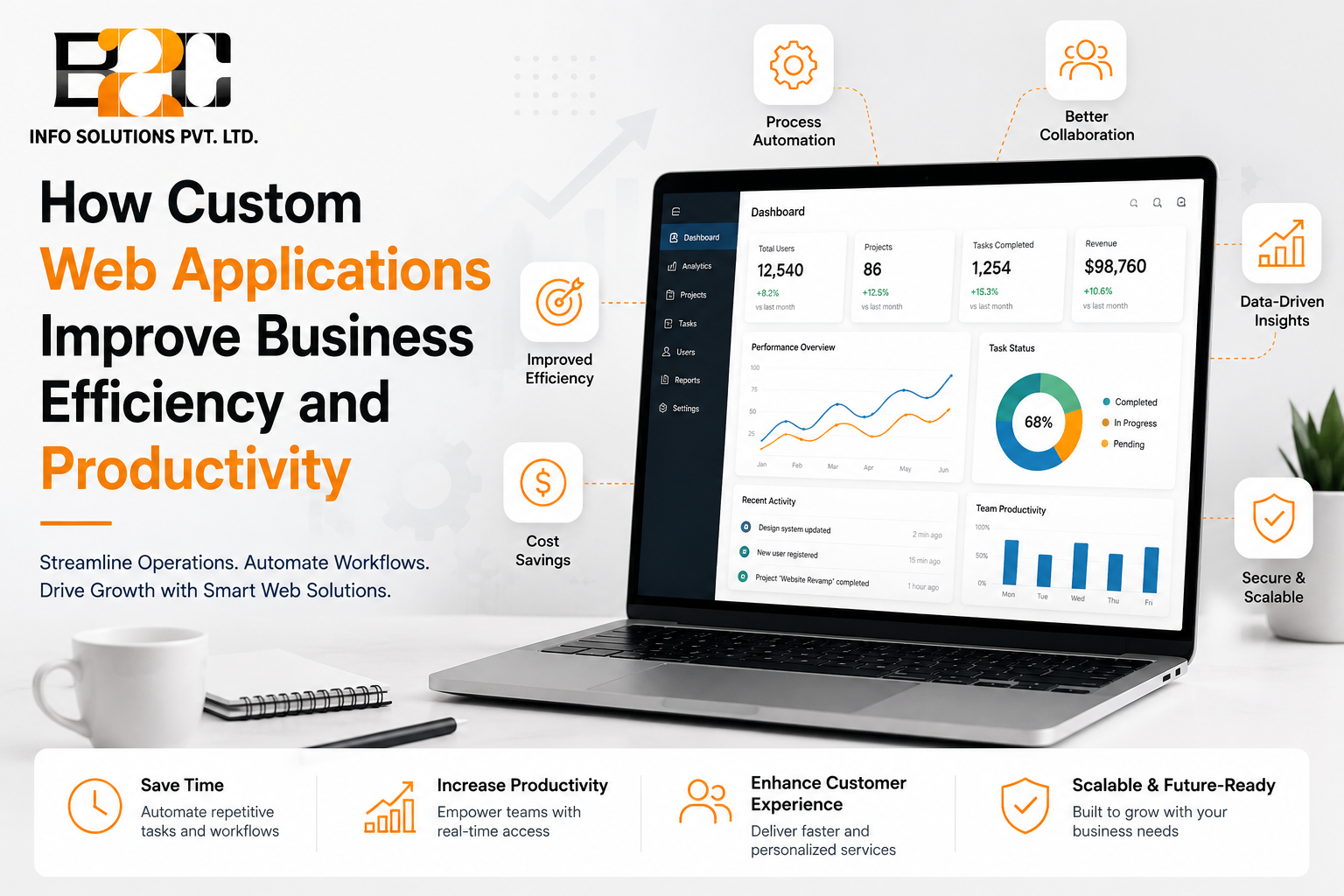
Most businesses eventually reach a point where generic software slows them down instead of helping them grow. Rigid workflows, limited customization, and features built for a broad market rather than a specific operation are why more CIOs and founders are turning to Custom Web Application Development to replace tools that no longer fit how the business actually works.
Off-the-shelf platforms are built to serve thousands of companies at once, which means they rarely match a specific business process closely. As operations grow more complex, that mismatch becomes expensive in lost time, manual workarounds, and staff forcing their work to fit a tool that was never designed for it.
Digital transformation has raised the bar further. Companies now expect software that automates routine work, integrates cleanly with existing systems, and scales as the business changes. A generic license fee might look cheaper upfront, but the hidden cost of workarounds, delayed reporting, and disconnected data often outweighs that initial savings within a year or two. This article explains why businesses are outgrowing generic software, how custom web applications improve efficiency, and what to look for in a development partner.
Off-the-shelf tools are designed for the average user, not a specific company. That means important workflows often need to be bent to fit the software instead of the other way around, forcing teams to build spreadsheet workarounds just to track what the core system cannot.
As companies add products, teams, and markets, their processes become harder to manage with a single generic tool. What worked for a ten-person team rarely holds up once a business operates across multiple departments, regions, or business units. Custom software can be shaped around the exact way a business actually operates instead of the other way around.
A custom web application can be built to match specific approval chains, reporting needs, and team structures, then scaled as the company adds users, locations, or business units without licensing limits or feature restrictions getting in the way.
Custom platforms can automate repetitive tasks and connect directly with existing systems, removing the manual data entry that generic software often requires between disconnected tools. This is one of the clearest efficiency gains businesses see after moving to a custom-built system.
Custom web applications automate repetitive steps such as approvals, notifications, and data entry, freeing staff to focus on higher-value work instead of manual processes. A logistics company, for example, can automate shipment status updates that once required a staff member to check multiple systems and manually notify customers.
Bringing scattered spreadsheets and disconnected tools into one platform gives teams a single source of truth, reducing the confusion that comes from managing data in multiple places and reconciling numbers that do not match between systems.
Built-in task assignment and approval routing keep work moving without manual follow-up, so nothing sits waiting in someone's inbox for a decision. Automated reminders and escalation rules ensure approvals do not stall a process for days at a time.
Live dashboards give managers visibility into operations as they happen, and shared workspaces let teams collaborate on the same data instead of passing files back and forth by email.
When operational data lives in one system, leadership can make decisions based on current numbers rather than outdated reports pulled together manually each week, which shortens the time between identifying a problem and acting on it.
A well-built application works smoothly across desktop and mobile, with navigation designed around how employees actually use the system day to day.
Dashboards tailored to each role, combined with permission controls, ensure employees see the data relevant to their job while sensitive information stays protected.
Modern custom web applications connect to CRMs, payment systems, and other tools through API integration, and cloud deployment keeps the platform accessible and easy to scale.
Built-in analytics turn raw activity into usable insight, while secure authentication, encryption, and regular backups protect business data from loss or unauthorized access.
A properly engineered application stays fast as usage grows, which matters directly for employee productivity and customer-facing reliability.
Automating manual work reduces the operational costs tied to repetitive tasks and gives employees more time for work that actually grows the business.
Centralized, real-time data lets managers respond to issues and opportunities quickly instead of waiting on reports compiled from separate systems.
Custom business web applications can be shaped around actual customer needs, supporting personalized service and better engagement than generic platforms allow.
Because the application is built for the business rather than a mass market, it can flex as requirements change, which supports stronger ROI over the life of the platform.
The framework matters, but the partner building the application matters just as much for long-term success.
A strong partner starts by understanding business goals and workflows in detail, rather than proposing a generic template solution.
Choosing the right technology stack and designing interfaces around real user behavior are what separate a usable application from one employees try to avoid.
A disciplined process of development, thorough testing, and controlled deployment reduces the risk of bugs and downtime after launch.
Ongoing maintenance and performance optimization keep an application reliable as usage grows. Businesses researching Custom web app development should look for a partner who treats improvement as an ongoing part of the relationship, not a one-time project.
Misaligned expectations between departments are a common source of delays. Structured workshops with stakeholders early in the project prevent costly changes later.
Connecting a new application to existing CRM or ERP systems can be complex. Mapping these integrations during planning, rather than after development starts, avoids rework.
Security requirements and maintenance needs grow as an application scales. Planning for this from the start keeps the system stable rather than reactive.
Working with a partner experienced in enterprise application development helps businesses avoid these pitfalls instead of discovering them after launch.
Artificial intelligence is increasingly built into business software, powering intelligent automation and predictive analytics that help teams anticipate issues before they escalate.
Cloud-native architecture continues to be the standard for scalable enterprise applications, and low-code platforms are speeding up development for less complex internal tools.
Machine learning is increasingly used for pattern recognition, and intelligent assistants embedded in business intelligence tools are helping teams query data in plain language rather than building reports manually.
Custom web applications have moved beyond being simple software projects. They have become strategic assets that support growth, efficiency, and competitive advantage. Businesses evaluating Enterprise web solutions can use these trends to plan a platform that stays relevant well beyond launch.
Generic software was never designed to fit a specific business perfectly, and as operations grow more complex, that gap becomes harder to ignore. Custom web application development gives businesses a platform built around their actual workflows, data, and goals.
If your business is ready to replace manual processes with a system built for how you actually work, working with an experienced partner makes the difference. Contact B2C Info Solutions to get started.
Why should businesses choose custom web applications instead of off-the-shelf software?
Custom web applications are built around a company's actual workflows and data, reducing manual workarounds and giving businesses features and integrations generic software cannot offer.
What industries benefit the most from custom web application development?
Industries with complex or specialized workflows, including finance, healthcare, logistics, manufacturing, and professional services, tend to benefit most from custom enterprise web applications.
How do custom web applications improve business productivity?
They automate repetitive tasks, centralize data into one platform, and give teams real-time visibility, which reduces manual work and speeds up decision-making.
Author Bio
JS Tomar is the Global Business Head at B2C Info Solutions, a premium digital technology company that has delivered over 1000+ web and mobile projects worldwide. With a deep background in strategic formulation and product engineering, he specializes in helping businesses leverage AI, cloud, and experience design to build disruptive software solutions. Based in Noida, JS is dedicated to nurturing a culture of excellence and delivering high-value digital transformations for clients across North America, Europe, and the Middle East.

 4 North
  52 Cornmarket
  C-25, C Block, 91springboard
 #02 - 161 IMM Building