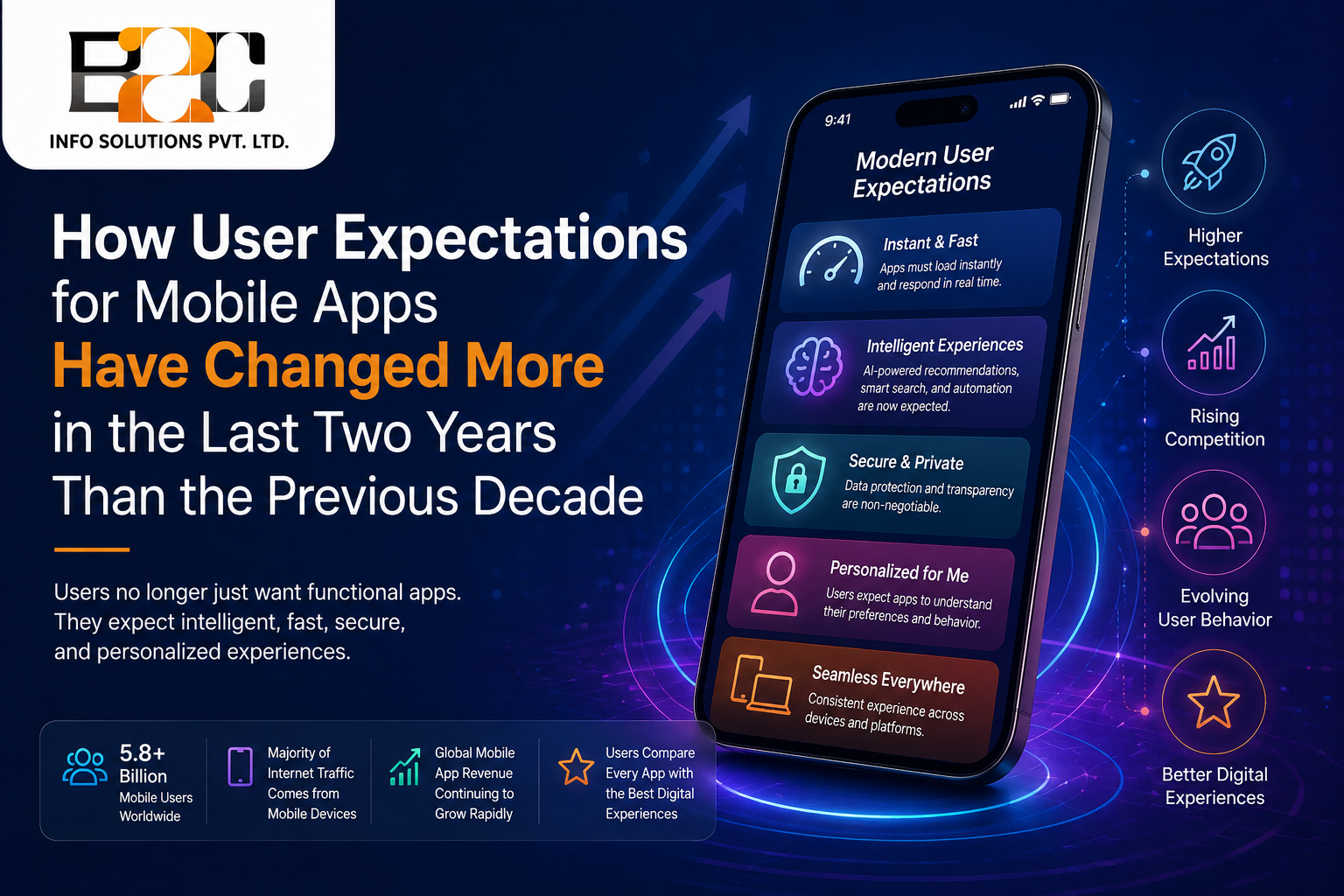
Mobile applications have always evolved, but the pace of change over the last two years has outstripped almost everything that came before it. Today's users expect apps to anticipate their needs, load instantly, and behave more like intelligent assistants than static software. Any Mobile App Development Company now has to design for a user who compares every app against the best experience they have ever had on their phone. That shift in reference point is what makes this moment feel different from the decade that preceded it.
This article examines why expectations moved so quickly, what changed in user behavior, and how businesses can respond with strategies grounded in real industry data.
For most of the last decade, mobile app development followed a fairly predictable curve. Screens got bigger, networks got faster, and app stores matured, so users adjusted gradually. The last two years broke that pattern for several converging reasons.
First, generative AI moved from a novelty into everyday consumer tools. Once people experienced instant, conversational, context aware responses in one app, they began expecting similar intelligence everywhere else. Second, according to DataReportal's ongoing global digital reports, time spent on mobile devices continues to represent the majority of overall internet usage worldwide. Third, platform providers such as Apple and Google have steadily raised their own design bars through updated Human Interface Guidelines and Material Design standards, which indirectly resets what users consider acceptable.
Together, these forces compressed years of behavioral change into a much shorter window, explaining why expectations feel so different today.
Several concrete behavioral shifts stand out when comparing today's mobile users with those from just two or three years ago.
None of these shifts happened in isolation, which is why their cumulative effect has been so pronounced.
Regardless of industry, certain baseline expectations now apply almost universally. Users expect apps to load within a few seconds, and according to Google's own developer research, longer load times correlate strongly with higher bounce rates. They also expect interfaces that feel native to the platform, whether that means Apple's design conventions on iOS or Material Design on Android, along with personalization that goes beyond a first name in a greeting message.
Security and privacy have also become baseline expectations. Users want clear visibility into what data is collected and simple controls to manage it. Accessibility has moved the same way, with users expecting apps to work well with screen readers and larger text from the first release.
Perhaps most importantly, users expect consistency. An app that performs beautifully in one moment but stutters in another erodes trust quickly, and that trust is hard to rebuild.
Forward thinking organizations are responding to these shifts with structural changes rather than surface level fixes. Many are investing in cross functional product teams that combine design, engineering, and data analysis from the earliest stages of a project.
There is also a noticeable shift toward continuous discovery. Instead of relying solely on annual research studies, businesses are using in app analytics and lightweight surveys to understand behavior in near real time, which helps teams identify friction points within weeks rather than months.
Investment patterns reflect this urgency. Enterprise organizations are increasingly partnering with specialists in custom mobile app development to modernize legacy applications that were never designed for today's expectations around speed and personalization. Rebuilding an existing app has become a strategic priority, particularly where the mobile channel drives a meaningful share of revenue.
Several broader industry trends are shaping where mobile app development is headed next. Artificial intelligence integration is arguably the most significant, with more apps incorporating on device or cloud based intelligence to power recommendations, search, and conversational interfaces. Firebase and other mobile backend platforms have made it considerably easier for teams to add these capabilities without building infrastructure from scratch.
Cross platform frameworks such as Flutter and React Native continue to mature, allowing teams to maintain a single codebase while delivering experiences that feel native on both iOS and Android. This matters for expectations because it lets smaller teams ship updates faster and maintain feature parity, which users now assume as a baseline.
Analysts at Gartner and IDC have both noted continued enterprise investment in mobile as a core channel. Sensor Tower and Appfigures data show app store competition remains intense, which places added pressure on product quality.
Meeting today's elevated expectations requires deliberate, ongoing effort rather than a single redesign. Several practices consistently separate high performing apps from the rest.
Organizations that treat these practices as ongoing disciplines, rather than one time checklist items, tend to maintain stronger user trust over time.
Looking ahead, the gap between static and intelligent applications will likely continue to widen. AI powered mobile apps are moving beyond chat interfaces into deeper workflow integration, where the app itself anticipates a user's next action based on context and history. Ambient computing, where mobile experiences connect more fluidly with wearables and voice assistants, is also becoming mainstream rather than experimental.
Privacy focused design will likely become even more central, as platforms continue tightening data permissions and users grow more selective about which apps earn their trust. Meanwhile, the technical bar for basic performance and reliability will keep rising, meaning features considered advanced today may become expected table stakes within another two years.
Organizations that treat mobile as a continuously evolving discipline, supported by strong mobile product engineering practices, will be better positioned to keep pace with these shifts than those that treat an app as a project with a defined end date.
The last two years have reshaped mobile user expectations more dramatically than the decade before them, driven by faster AI adoption, rising platform standards, and users who now compare every app against the best experience on their phone. Businesses that invest in performance, personalization, accessibility, and continuous discovery are far better positioned to earn and retain user trust. For organizations planning to build a new application or modernize an existing one, it is worth planning carefully before development begins. Reaching out to Contact our mobile app experts can help clarify the right approach based on specific business goals and user needs, rather than guessing at a strategy in isolation.
Why have mobile app user expectations changed so quickly in the last two years?
The rapid adoption of AI powered features, rising design standards from Apple and Google, and increased time spent on mobile devices have combined to accelerate expectations faster than in previous years.
What do users expect most from a mobile app today?
Users generally expect fast performance, native feeling design, meaningful personalization, clear privacy practices, and consistent reliability across every interaction.
How can a business keep up with changing mobile user expectations?
Businesses can stay aligned by investing in continuous user research, treating performance and accessibility as core features, and working with experienced development partners to modernize existing applications.
Author Bio
JS Tomar is the Global Business Head at B2C Info Solutions, a premium digital technology company that has delivered over 1000+ web and mobile projects worldwide. With a deep background in strategic formulation and product engineering, he specializes in helping businesses leverage AI, cloud, and experience design to build disruptive software solutions. Based in Noida, JS is dedicated to nurturing a culture of excellence and delivering high-value digital transformations for clients across North America, Europe, and the Middle East.

 4 North
  52 Cornmarket
  C-25, C Block, 91springboard
 #02 - 161 IMM Building