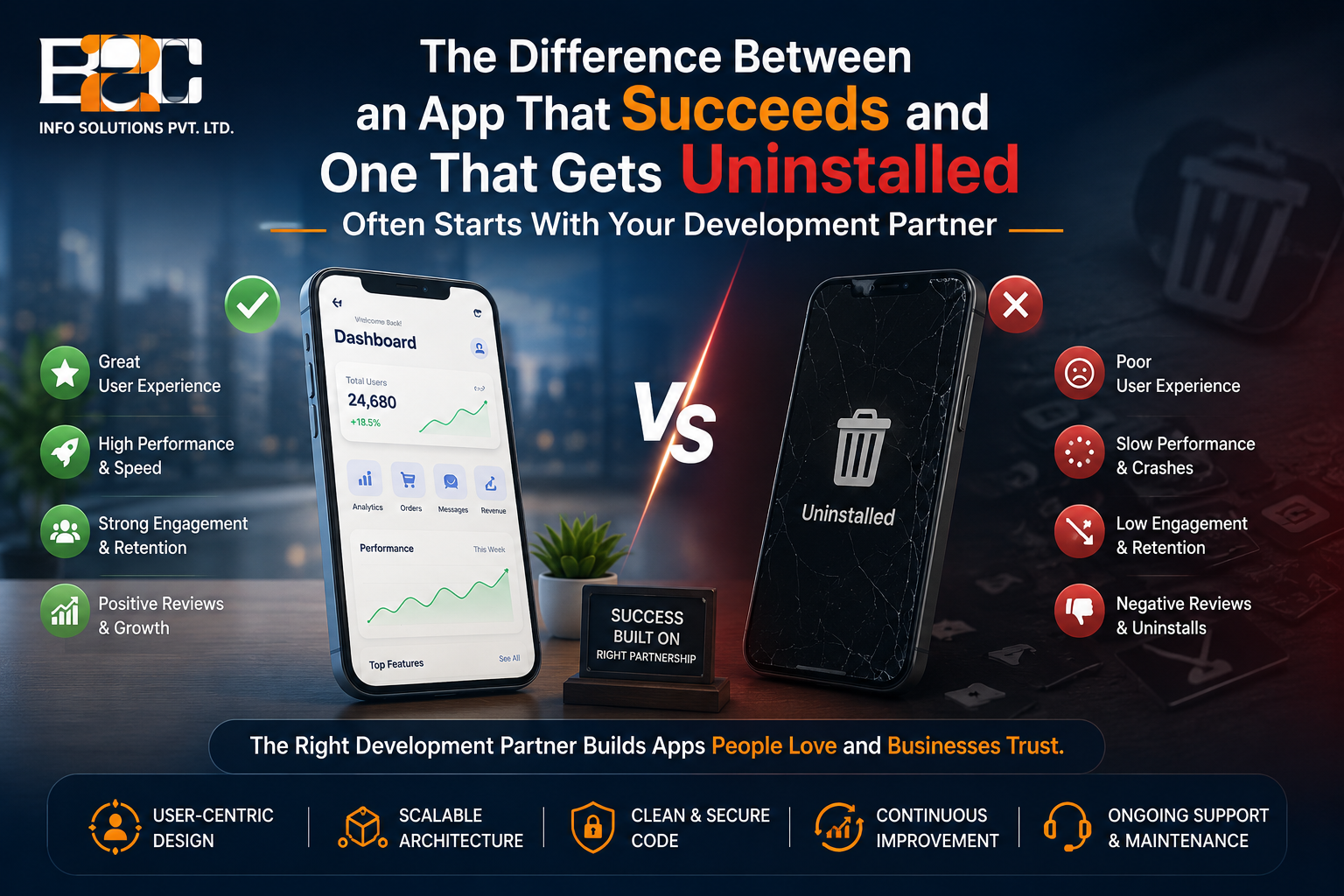
Thousands of mobile applications launch every year, and a striking number of them lose most of their users within the first few weeks. The problem is rarely a lack of ambition. It is usually a gap between the idea and the engineering, design, and long-term thinking required to turn that idea into something people keep using. Choosing the right Mobile App Development Company often determines whether an application becomes a durable business asset or joins the long list of apps quietly deleted after a single disappointing session.
Founders and product leaders often assume the hardest part of building an app is the idea itself. In practice, the idea is usually the easiest part. Turning it into a fast, reliable, and genuinely useful product is where most projects run into trouble, and where the choice of development partner starts to matter far more than most teams expect at the outset.
This article looks at why apps fail after launch, what separates high-performing products from the rest, and how the right development partner changes the outcome from the first line of code onward.
Confusing navigation, cluttered screens, and unclear calls to action push users away faster than almost any other issue. Users rarely tolerate a learning curve on a mobile app the way they might with desktop software, largely because a competing app is always one tap away in the app store. If the first few taps feel effortful, most users simply leave, and they rarely come back to give the app a second chance.
Load times, laggy transitions, and crashes are among the most common reasons users abandon an app permanently. Performance problems often stem from decisions made early in development, such as unoptimized code, poor server architecture, or a database that was never designed to scale.
An app built around a feature list rather than a genuine customer need will struggle regardless of how polished the interface looks. Sustainable engagement depends on the app solving a real problem consistently, not simply offering novelty during the first few sessions. Once the novelty wears off, only genuine utility keeps a user opening the app week after week.
Users expect near-instant responsiveness. Successful apps are engineered with performance as a core requirement from day one, not an optimization pass added after launch when problems have already surfaced.
The best mobile products minimize the number of steps between opening the app and completing a meaningful action. Every additional screen, form field, or decision point is an opportunity for a user to abandon the task.
High-performing apps evolve based on how people actually use them. Teams that treat launch as the beginning rather than the end consistently outperform those that consider the project finished at release.
An experienced Mobile App Development Company starts with business goals, not a feature wish list. Understanding what success looks like for the business, whether that is transaction volume, subscription retention, or engagement frequency, shapes every technical decision that follows, from how the backend is structured to which features ship first and which can wait for a later release.
Technology decisions made early, such as choosing between native, Flutter, or React Native development, have long-term consequences for performance, maintenance cost, and how quickly new features can ship. Experienced teams choose the stack that fits the product's actual requirements rather than defaulting to what is fastest to build.
Rigorous code review, automated testing, and clean architecture reduce technical debt that would otherwise slow down every future update. Cutting corners during initial development is one of the most common reasons app updates become slower, more expensive, and riskier over time, often forcing a costly rebuild years earlier than the business anticipated.
Apps that adapt content, recommendations, or workflows to individual user behavior consistently see stronger retention than one-size-fits-all experiences. Personalization does not need to be complex to be effective; even simple behavioral triggers can meaningfully improve engagement.
Teams that build structured channels for collecting and acting on user feedback, through in-app prompts, support tickets, or app store reviews, catch usability problems long before they show up in retention metrics.
Product analytics reveal where users drop off, which features drive the most engagement, and which parts of the app are ignored entirely. This custom mobile app development services approach, grounded in real usage data rather than assumptions, is what separates apps that improve steadily from apps that stagnate after launch.
Ongoing monitoring catches performance regressions, crashes, and slow API responses before they affect a large share of users. Waiting for user complaints to surface a problem usually means the damage to retention has already occurred.
Mobile operating systems, third-party libraries, and security standards change constantly. Apps that are not actively maintained accumulate vulnerabilities over time, creating risk for both the business and its users.
Regular, well-considered feature updates signal to users that an app is actively maintained and improving, which supports both retention and organic growth through positive reviews and word of mouth. Apps that go quiet for long stretches between updates tend to lose the trust of their most active users first.
Evaluate depth across relevant platforms and frameworks, and ask for specific examples of technical challenges solved in past projects rather than general claims of capability.
A team familiar with the regulatory and operational realities of a specific industry, such as healthcare or financial services, will avoid costly mistakes that generalist teams often make.
Clear reporting structures, predictable check-ins, and transparent handling of setbacks during the sales process are strong indicators of how a team will communicate once the project is underway.
Ask how the team structures sprints, handles scope changes, and validates work before release. A disciplined, transparent methodology reduces the risk of scope creep and missed deadlines.
Confirm what happens after launch. A defined plan for monitoring, updates, and ongoing enterprise mobile application solutions support indicates a partner thinking beyond the initial delivery date.
The strongest partners bring forward ideas based on evolving user behavior and platform capabilities, rather than waiting to be told what to build next.
App success depends on far more than a good idea. It depends on user experience decisions made early, performance engineering that holds up under real-world conditions, and a long-term commitment to improvement that continues well past launch day. Every one of those outcomes traces back to the development partner chosen at the start of the project.
Choosing an experienced Mobile App Development Company significantly improves product quality, customer retention, scalability, and long-term business success. Businesses planning a new mobile application, or looking to rescue one that is underperforming, are welcome to contact our mobile app experts to discuss what a stronger technical and product foundation could look like.
Users typically uninstall apps due to poor performance, confusing navigation, or a lack of ongoing value after the first few uses. Slow load times, frequent crashes, and interfaces that require too much effort to understand are among the most common reasons. Apps that fail to evolve based on user behavior also tend to lose engagement steadily until users abandon them entirely.
Successful mobile applications combine fast, reliable performance with simple user journeys and a clear, consistent value proposition. They are built on solid technical architecture that supports growth, and they continue to improve after launch through analytics-driven updates and responsiveness to user feedback rather than remaining static once released to app stores.
Evaluate technical expertise, relevant industry experience, and communication transparency during the sales process itself. Ask about development methodology, how scope changes are handled, and what long-term support looks like after launch. Strong partners can point to specific past projects and speak candidly about challenges encountered, rather than offering only general claims of capability.
Author Bio
JS Tomar is the Global Business Head at B2C Info Solutions, a premium digital technology company that has delivered over 1000+ web and mobile projects worldwide. With a deep background in strategic formulation and product engineering, he specializes in helping businesses leverage AI, cloud, and experience design to build disruptive software solutions. Based in Noida, JS is dedicated to nurturing a culture of excellence and delivering high-value digital transformations for clients across North America, Europe, and the Middle East.

 4 North
  52 Cornmarket
  C-25, C Block, 91springboard
 #02 - 161 IMM Building