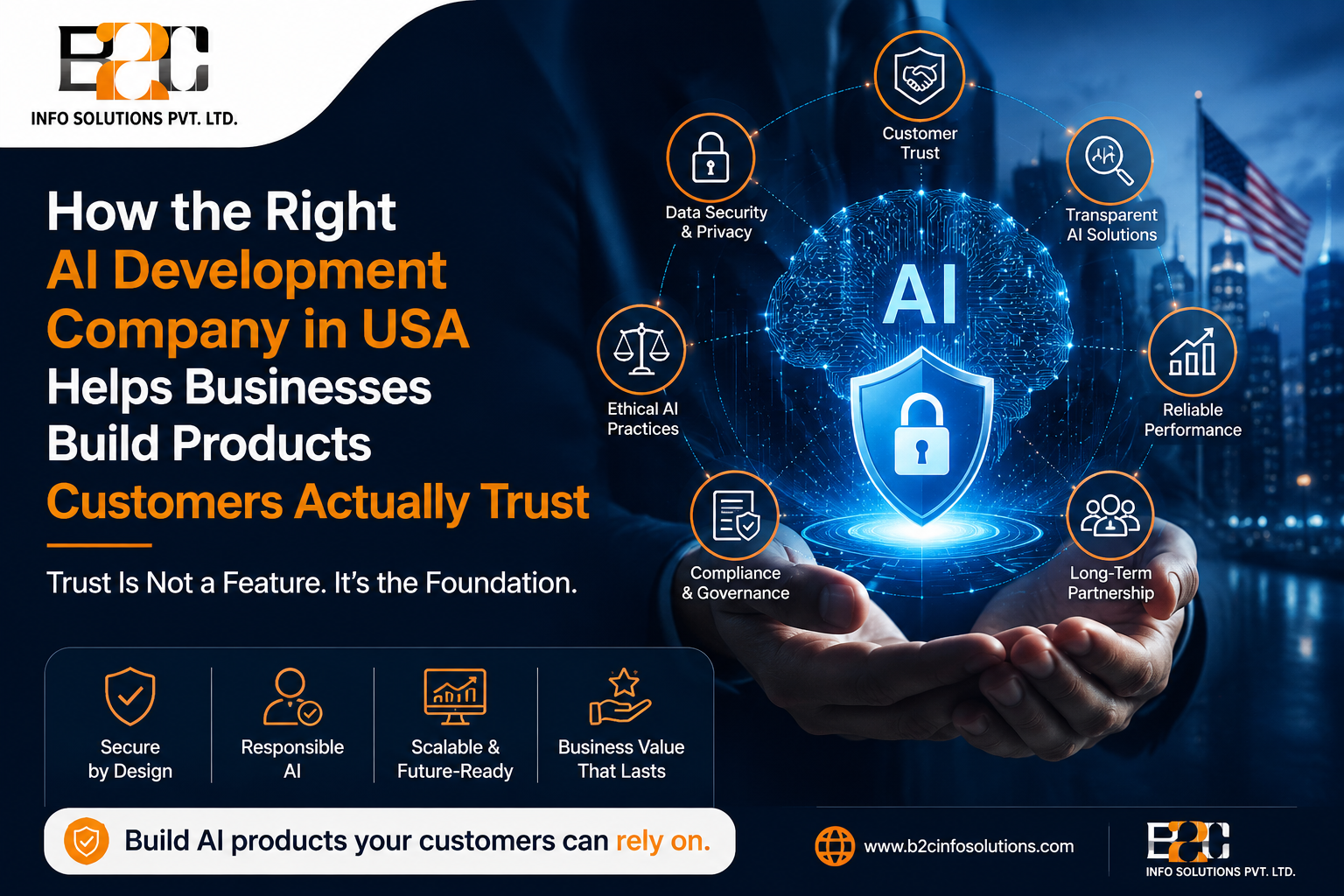
AI-powered products are appearing across nearly every industry, from healthcare diagnostics to financial services and customer support. As adoption accelerates, businesses are discovering that technical capability alone is no longer enough to win customers over. Working with an experienced AI Development Company in USA increasingly means building products people are willing to trust, not just products that function correctly.
Customer trust has quietly become one of the strongest competitive advantages in the AI market. Two companies can launch similar AI features, yet the one that communicates clearly, protects user data, and behaves predictably will earn far more sustained adoption than the one that treats trust as an afterthought.
This article explores why trust has become central to AI product success, how it should be built from the earliest planning stages, and what businesses should look for in a development partner capable of delivering AI that customers genuinely rely on.
Customer expectations around AI have shifted significantly. Users no longer accept a product simply because it uses artificial intelligence; they want to understand how it works and why they should trust its output. This is especially true in sensitive categories like healthcare, finance, and hiring, where AI decisions can carry real consequences.
Consumer concerns around AI, including worries about data privacy, bias, and job displacement, mean that businesses face real adoption barriers if trust is not addressed directly. A financial services app that recommends investment decisions, for example, will struggle to gain users if it cannot clearly explain the reasoning behind its recommendations.
Transparency and reliability directly influence long-term brand reputation. Companies that are open about how their AI systems work, and consistent in how those systems perform, tend to see stronger user retention than those relying on AI as a marketing feature alone.
Many businesses treat trust as something to address after a product launches, but the strongest AI products build it in from the planning stage. Clearly defining business objectives before development begins ensures the AI system is designed to solve a real problem rather than to showcase technology for its own sake.
Ethical AI planning and user-centered product design go hand in hand. A healthcare technology company building a diagnostic support tool, for instance, needs clinical input and patient safety considerations embedded in the design process from day one, not layered on afterward.
Data quality, human oversight, and stakeholder alignment across legal, product, and engineering teams all shape whether an AI system behaves reliably once it reaches real users. Skipping these steps to move faster almost always creates larger problems, and larger costs, later in the product lifecycle.
Explainable AI allows users and stakeholders to understand why a system produced a particular output, which is essential for building confidence in automated decisions. Fair decision making and active bias reduction efforts help ensure AI systems do not unintentionally disadvantage certain groups of users.
Responsible AI development requires more than good intentions; it requires structured processes. Businesses working with a partner that offers genuine Custom AI Development Services benefit from established frameworks for testing fairness, documenting model behavior, and maintaining human oversight over automated decisions.
Continuous monitoring and clear AI governance policies ensure that responsible practices are maintained well after launch, not just during initial development. As models are retrained on new data, ongoing governance helps catch unintended drift before it affects real customers.
Security is one of the fastest ways to either build or destroy customer confidence in an AI product. Privacy by design, where data protection is built into the architecture from the start rather than added later, has become a baseline expectation rather than a differentiator.
Secure infrastructure, strong data governance, and proactive cybersecurity measures protect both the business and its customers as AI systems process increasingly sensitive information. Regulatory compliance is also essential, and businesses operating in regulated industries should reference established frameworks such as SOC 2 or HIPAA where relevant, without overstating certifications they have not actually obtained.
Risk management and secure AI deployment practices, including careful access controls and regular security audits, directly impact customer confidence. A single publicized data incident can undo years of trust building, which is why security should be treated as a continuous discipline rather than a one-time compliance checkbox.
Strategic consulting and thorough product discovery at the outset help ensure an AI system is built around genuine business needs rather than generic capability. Strong AI architecture, paired with real technical excellence, prevents the performance and reliability issues that erode customer trust.
Industry expertise allows a development partner to anticipate challenges specific to a given sector, whether that involves regulatory nuance in healthcare or fraud patterns in financial services. Scalable implementation ensures the product can grow without requiring a costly rebuild once demand increases.
Perhaps most importantly, businesses should look for partners rather than vendors. A vendor delivers a project and moves on. A partner stays engaged through long-term collaboration and continuous optimization, treating the AI product as an evolving asset rather than a finished deliverable.
Continuous testing throughout development, rather than only before launch, helps catch reliability and fairness issues early. Structured customer feedback loops allow businesses to understand how real users experience the AI system and where confusion or distrust tends to arise.
Responsible deployment practices, including gradual rollouts and careful monitoring of early results, reduce the risk of widescale issues. Ongoing performance monitoring and regular model improvements keep the product accurate and dependable as usage patterns evolve.
Transparent communication with customers about how AI is used, and long-term maintenance commitments after launch, complete the picture. Businesses that treat these practices as ongoing discipline, supported by genuine Enterprise AI Development expertise, consistently build products that earn lasting customer confidence.
Trust drives AI adoption more consistently than any single feature or capability. Security cannot be treated as optional, and transparency directly improves customer confidence in how AI systems make decisions. Responsible AI practices create sustainable business growth, while choosing experienced partners meaningfully reduces implementation risk.
If your business is planning to build secure, transparent, and trustworthy AI-powered products, connect with the AI experts at B2C Info Solutions to discuss how to bring your product to market with confidence.
Trust determines whether customers actually adopt and continue using an AI-powered product, regardless of how advanced the underlying technology is. Users are increasingly cautious about how AI systems handle their data and make decisions, especially in sensitive categories like healthcare and finance. Products that are transparent, secure, and consistent in their performance earn stronger long-term engagement than those that rely on AI as a marketing feature. Without trust, even highly capable AI systems often struggle to achieve meaningful adoption.
Businesses can improve AI transparency by clearly communicating how a system reaches its conclusions, using explainable AI techniques where possible rather than relying purely on black box models. Providing users with context about what data is used and how decisions are made builds confidence over time. Regular communication about updates, limitations, and known issues also helps. Combining technical explainability with honest, ongoing communication tends to build far more trust than technical transparency alone.
Businesses should look for a company with demonstrated technical expertise, relevant industry experience, and a clear commitment to responsible AI practices, including fairness testing and human oversight. Strong data security and compliance awareness are essential, particularly for businesses in regulated industries. Equally important is the relationship structure itself. Companies that offer long-term collaboration and continuous optimization tend to deliver more reliable, trustworthy AI products than those focused only on a single project delivery.

 4 North
  52 Cornmarket
  C-25, C Block, 91springboard
 #02 - 161 IMM Building