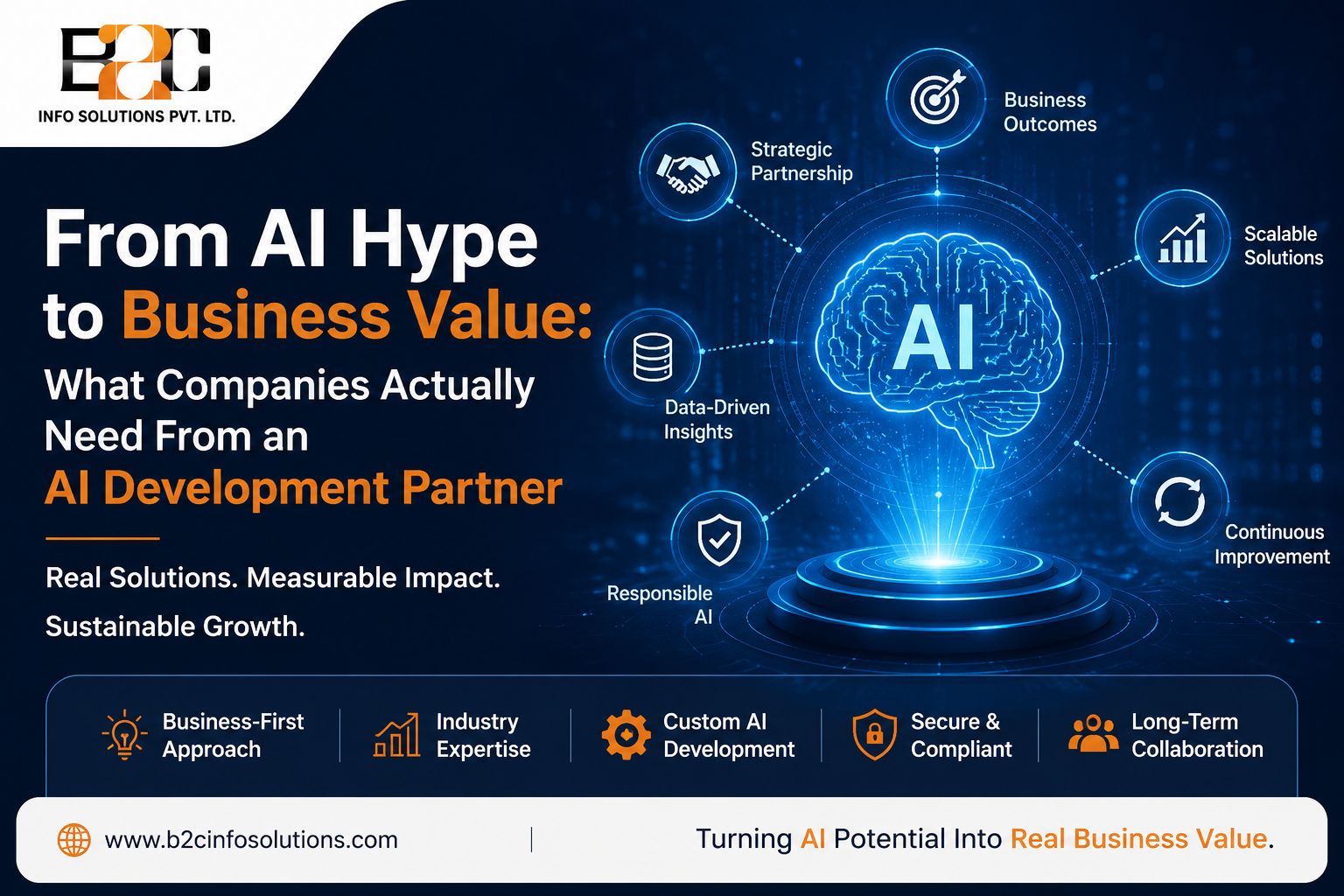
AI adoption is accelerating across nearly every industry, from retail and healthcare to logistics and financial services. Yet despite growing budgets and executive enthusiasm, many organizations still struggle to turn AI investments into measurable business value. Working with an experienced AI Development Company in India often makes the difference between a pilot project that never scales and a solution that genuinely transforms operations.
Technology alone rarely produces results. The models, algorithms, and infrastructure that power AI are only as effective as the strategy and implementation behind them. Without the right partner guiding data readiness, business alignment, and deployment, even the most advanced AI tools can stall before they deliver returns.
This article explains why so many AI initiatives underdeliver, what separates a capable implementation partner from the rest, and how business leaders can approach AI adoption in a way that produces lasting, measurable outcomes.
A surprising number of AI initiatives fail not because the technology is flawed, but because the groundwork was incomplete. A lack of clear business objectives is one of the most common causes. Teams sometimes pursue AI because competitors are doing it, without defining what specific problem the technology is meant to solve.
Unrealistic expectations compound the issue. Leadership may expect immediate, dramatic results, when most successful AI programs require iterative testing and refinement over several months. Poor implementation planning, including insufficient timelines and unclear ownership, adds further risk.
Weak data foundations are another frequent obstacle. A retail company attempting to build a demand forecasting model with incomplete or inconsistent sales data will struggle regardless of how sophisticated the underlying algorithm is. Lack of executive alignment and ignoring organizational readiness, such as employee training and change management, round out the list of reasons AI projects stall despite strong underlying technology.
Terms like generative AI, machine learning, and intelligent automation dominate industry conversations, but businesses that succeed with AI tend to think beyond the buzzwords. A business-first mindset starts with a specific operational challenge and works backward to determine whether AI is genuinely the right solution.
Industry expertise matters as much as technical skill. A logistics company implementing AI for route optimization needs a partner who understands supply chain constraints, not just neural network architecture. This problem-first approach to practical AI implementation consistently outperforms technology-first thinking.
Successful AI adoption strategies usually start small, with a well-scoped use case that can prove value quickly, such as automating a repetitive back-office process, before expanding into more complex applications like predictive analytics or generative AI development. AI should ultimately solve a real business problem rather than simply following a market trend.
Choosing the right partner has a direct impact on whether an AI initiative succeeds. Technical expertise across machine learning solutions, data engineering, and AI software development forms the foundation, but it is not the only requirement.
Strong AI strategy consulting helps businesses identify which use cases will deliver the strongest return before any code is written. Reliable partners offering Custom AI Development Services also prioritize transparency, explaining how models make decisions rather than treating them as black boxes.
Responsible AI practices, along with security and compliance safeguards, protect both the business and its customers as AI systems scale. Long-term collaboration and continuous optimization matter just as much as the initial build, since AI models require ongoing monitoring and refinement to stay accurate and relevant as business conditions change.
AI creates value when it is tied to outcomes leadership actually cares about. Process automation reduces manual workload and operational costs, while improvements in customer experience, such as intelligent chatbots or personalized recommendations, drive engagement and retention.
Intelligent decision making, supported by predictive analytics, allows businesses to anticipate demand, detect risk, or identify opportunities earlier than manual analysis would allow. A manufacturing company using predictive maintenance models, for example, can reduce equipment downtime and avoid costly unplanned repairs.
Operational efficiency, revenue growth, and cost optimization should be tracked as concrete KPIs rather than vague aspirations. Businesses that measure AI success through metrics like reduced processing time, increased conversion rates, or lower error rates gain a much clearer picture of return on investment than those that focus only on whether a model was successfully deployed.
An AI solution that works well in a controlled pilot can struggle once it faces real-world volume and complexity. Flexible AI architecture and scalable infrastructure should be planned from day one, not added as an afterthought once a proof of concept succeeds.
Continuous model improvement keeps performance accurate as data patterns shift over time, while responsible AI governance ensures decisions remain fair and explainable as the system grows. Data quality and security cannot be treated as one-time checkpoints; they require ongoing attention as new data sources and use cases are added.
Future readiness also depends on how well an AI solution integrates with existing business systems, from CRM platforms to enterprise resource planning tools. Scalable AI applications that were designed with integration in mind avoid the costly rework that often accompanies systems built in isolation.
Before committing to a partnership, businesses should ask several important questions. Does the company have relevant industry experience, or only general AI capability? What is their deployment methodology, and how do they handle testing before a solution goes live?
What ongoing maintenance strategy do they offer once the initial project is complete? How is data governance handled, and what model monitoring practices are in place to catch performance drift early? AI security deserves particular attention, since AI systems often process sensitive business and customer data.
Perhaps most importantly, is the relationship structured as a long-term partnership or a one-time project? Providers offering genuine Business AI Solutions typically emphasize sustained collaboration over transactional delivery, since enterprise AI systems require continuous refinement long after the initial deployment.
AI success depends less on the sophistication of the technology and more on how thoughtfully it is applied. Businesses that focus on measurable outcomes, build AI around real operational problems, and choose experienced partners consistently outperform those chasing the latest trend.
Investing in scalable AI solutions and thinking long term, rather than pursuing quick wins, positions organizations to benefit as their data, infrastructure, and business needs evolve. If your organization is planning to implement AI solutions that create measurable business value, connect with the AI specialists at B2C Info Solutions to discuss a strategy built around your specific goals.
An AI development partner helps businesses identify where artificial intelligence can create genuine value, then designs, builds, and deploys solutions aligned with those goals. This typically includes strategy consulting, data engineering, model development, integration with existing systems, and ongoing monitoring after launch. A strong partner also helps businesses avoid common pitfalls, such as building solutions without clean data or deploying models without a plan for long-term maintenance, which significantly improves the odds of measurable success.
AI creates measurable value when it is tied directly to business outcomes such as reduced operational costs, faster decision making, improved customer experience, or increased revenue. Rather than measuring success by whether a model was deployed, businesses should track concrete KPIs like process efficiency gains, error reduction, or conversion improvements. This requires setting clear objectives before development begins and consistently monitoring performance afterward, so that AI investments can be adjusted and improved based on real results rather than assumptions.
Businesses should evaluate potential partners based on relevant industry experience, technical depth, and a demonstrated ability to align AI solutions with business objectives rather than generic technology. Transparency in how models make decisions, strong data governance practices, and a clear plan for ongoing maintenance are equally important. It also helps to choose a partner who approaches the relationship as a long-term collaboration rather than a one-time project, since most successful AI systems require continuous refinement well after initial deployment.

 4 North
  52 Cornmarket
  C-25, C Block, 91springboard
 #02 - 161 IMM Building