Table of Contents
Mobile apps no longer compete on features alone. They compete on speed to market, consistency across devices, and the ability to evolve as business needs change. This is why more founders, CTOs, and product leaders are partnering with a Flutter Development Company to build applications that work seamlessly across Android, iOS, web, and desktop from a single codebase.
Native development once was the default, offering strong performance but requiring two codebases and release calendars. As budgets tightened, that model became harder to justify.
Flutter changed the calculation. Backed by Google and built on Dart, it lets one team build and ship an app that looks and feels native everywhere. This article explains why cross-platform development is becoming the standard, why Flutter leads the category, and what businesses should know before committing to a build.
Startups and enterprises are under pressure to launch quickly and validate ideas before competitors do. Cross-platform frameworks compress timelines, replacing parallel Swift and Kotlin builds with a single implementation.
Customers expect an app to look and behave the same way on an iPhone or an Android device. Cross-platform mobile apps built on a shared codebase make that consistency achievable without duplicating UI work.
Markets shift quickly, and roadmaps need to shift with them. A single codebase means a fix can be pushed to every platform at once, instead of waiting on two engineering tracks.
Cross-platform app development lowers the engineering hours needed for the same outcome, which is why businesses are moving beyond native-only strategies.
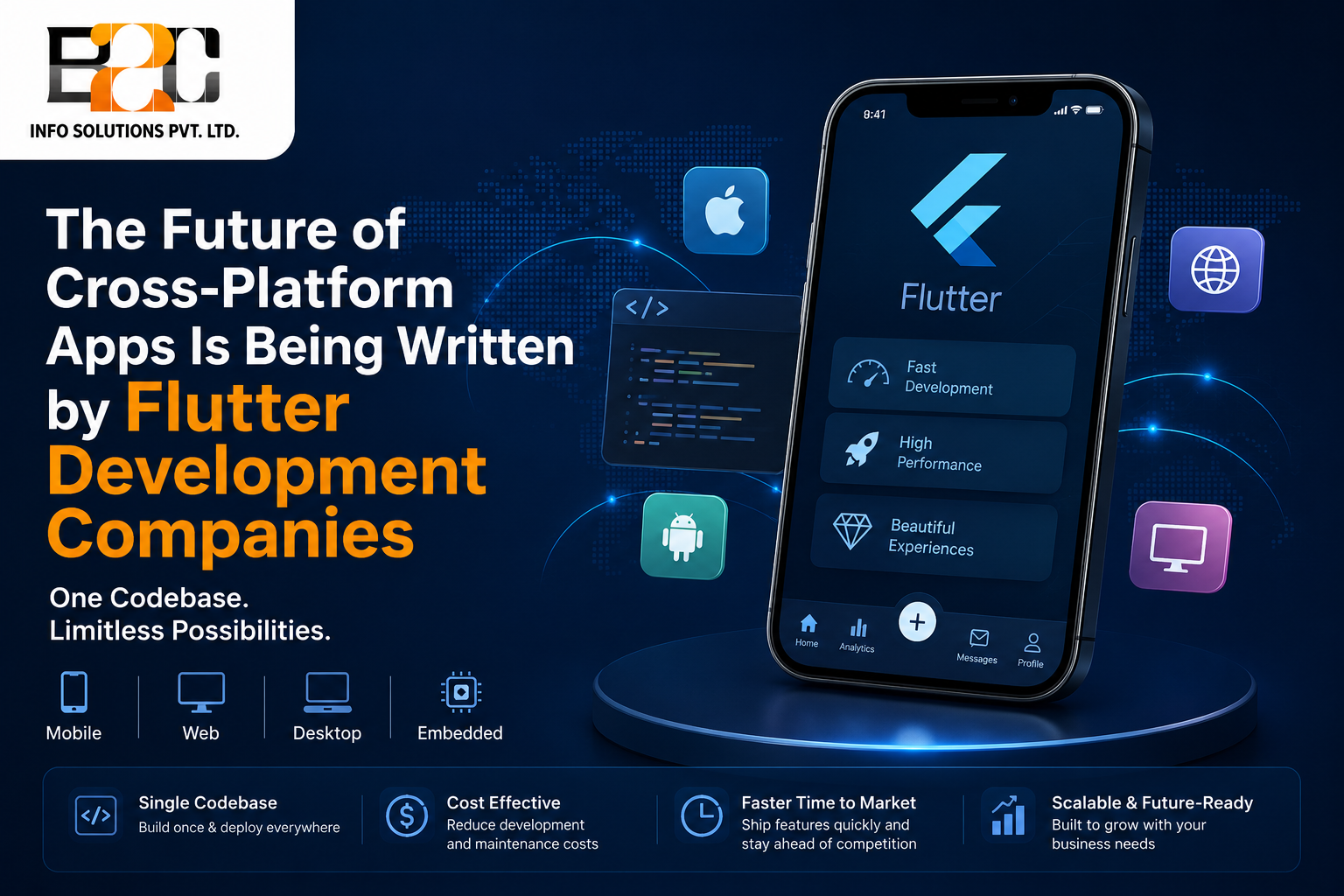
Flutter lets teams write one codebase and deploy to Android, iOS, web, and desktop, so a single investment in Flutter application development supports a far wider footprint of devices.
Unlike frameworks that rely on a JavaScript bridge, Flutter compiles directly to native ARM code, producing smoother animations that close much of the old performance gap.
Hot Reload lets developers see the result of a code change in under a second without restarting the app, shortening the feedback loop and speeding up QA cycles.
Flutter's widget-based rendering engine draws every pixel itself rather than depending on native components, giving designers precise control over how an interface looks on every device.
Because Flutter compiles to native code and manages its own rendering pipeline, applications can scale from a simple MVP to a full enterprise application without a framework migration.
Building one codebase instead of two is the biggest driver of savings in Flutter app development, since businesses typically need a smaller engineering team.
A Flutter Development Company can move a product from concept to a working MVP faster than a team building separate iOS and Android apps.
A single codebase means one place to fix bugs and update dependencies, reducing the maintenance burden that grows over the life of a native app.
When development and maintenance costs fall while user experience stays consistent, ROI improves, and custom Flutter app development lets companies reinvest savings into growth.
Consistent performance and design across devices reduces friction as customers move between an iPhone and Android phone, supporting retention.
Flutter ships with an extensive widget library covering layout, material, and Cupertino design components, giving teams the building blocks for a polished interface.
Flutter's rendering engine, Skia, allows fluid animations and layouts that adapt naturally to different screen sizes as apps expand from phones to tablets and desktop.
Well-structured Flutter applications separate business logic from UI using patterns such as BLoC or Provider, keeping the codebase maintainable as an app grows.
Flutter apps commonly integrate with REST and GraphQL APIs, Firebase, and other cloud backends, connecting the app to existing data systems.
Flutter supports secure authentication flows, encrypted local storage, and identity provider integration, helping businesses meet data protection needs.
Because Flutter compiles ahead-of-time to native machine code, apps generally start faster and run more efficiently than apps relying on an interpreted bridge.
Choosing the right partner matters as much as choosing the framework. A capable Flutter Development Company brings a full lifecycle of services, not just code.
An experienced team first assesses business goals, then designs an architecture that supports growth instead of requiring a rebuild later.
Strong Flutter partners pair design and engineering closely, translating requirements into interfaces that are consistent and easy to use.
A mature process includes structured sprints, thorough testing, and a clear deployment pipeline to the App Store and Google Play, reducing delays or rejections.
Cross-platform mobile app development does not end at launch. Ongoing support keeps an application competitive as expectations evolve. Businesses exploring Flutter mobile app solutions should look for a partner that treats post-launch support as part of the core engagement.
Applications that skip architecture planning in favor of speed often accumulate technical debt that leads to costly rewrites.
Not every native library has a mature Flutter equivalent, so businesses should confirm early that integrations such as payment gateways or hardware SDKs have reliable Flutter support.
Payment processing and backend systems need careful testing across platforms, since edge cases can differ subtly between Android and iOS.
Thorough testing across devices and OS versions remains essential, and attention to memory management prevents slowdowns.
Businesses reduce risk by working with a partner with direct experience solving these challenges.
Flutter's roadmap continues to expand beyond mobile. Google has extended stable support for web and desktop, letting a single codebase reach browsers and desktop systems alongside Android and iOS app development targets.
Artificial intelligence is increasingly built into mobile experiences, from personalized recommendations to on-device inference, and Flutter's plugin ecosystem makes it straightforward to connect apps to AI-powered backends.
The rise of super apps, combining messaging, payments, and services into one platform, favors frameworks like Flutter that support complex, modular applications from a single codebase. Flutter is also used in embedded devices and IoT contexts. This expanding reach strengthens the case for enterprise Flutter development as a strategic platform.
Flutter has moved beyond being simply a cost-saving alternative to native development. It has become a strategic choice for businesses that need scalable mobile apps, consistent user experiences, and the flexibility to expand across web, desktop, and emerging device categories. Companies that treat Flutter as a long-term platform investment are best positioned to benefit. Businesses evaluating scalable Flutter applications can use this momentum to plan a build that supports growth well beyond launch.
The future of mobile development is being shaped by teams that can move fast without sacrificing quality, and Flutter has positioned itself at the center of that shift. From faster MVPs to enterprise-grade applications spanning mobile, web, and desktop, Flutter software development gives businesses a practical path to reach more users with less duplicated effort.
If your business is ready to build a scalable, high-performing application, working with an experienced partner makes the difference between a functional app and one that drives real growth. Contact B2C Info Solutions to get started.
Why are businesses choosing Flutter over traditional app development?
Flutter allows one team to build for Android, iOS, web, and desktop from a single codebase, reducing cost and development time while still delivering native-like performance.
What types of applications can be built using Flutter?
Flutter supports a wide range of applications, including e-commerce, fintech and banking apps, enterprise mobile applications, on-demand service platforms, and increasingly, web and desktop applications from the same codebase.
Why should businesses work with a Flutter Development Company?
An experienced Flutter Development Company brings architecture planning, design, development, testing, and maintenance under one roof, reducing risk and helping the application scale as the business grows.
Author Bio
JS Tomar is the Global Business Head at B2C Info Solutions, a premium digital technology company that has delivered over 1000+ web and mobile projects worldwide. With a deep background in strategic formulation and product engineering, he specializes in helping businesses leverage AI, cloud, and experience design to build disruptive software solutions. Based in Noida, JS is dedicated to nurturing a culture of excellence and delivering high-value digital transformations for clients across North America, Europe, and the Middle East.

 4 North
  52 Cornmarket
  C-25, C Block, 91springboard
 #02 - 161 IMM Building