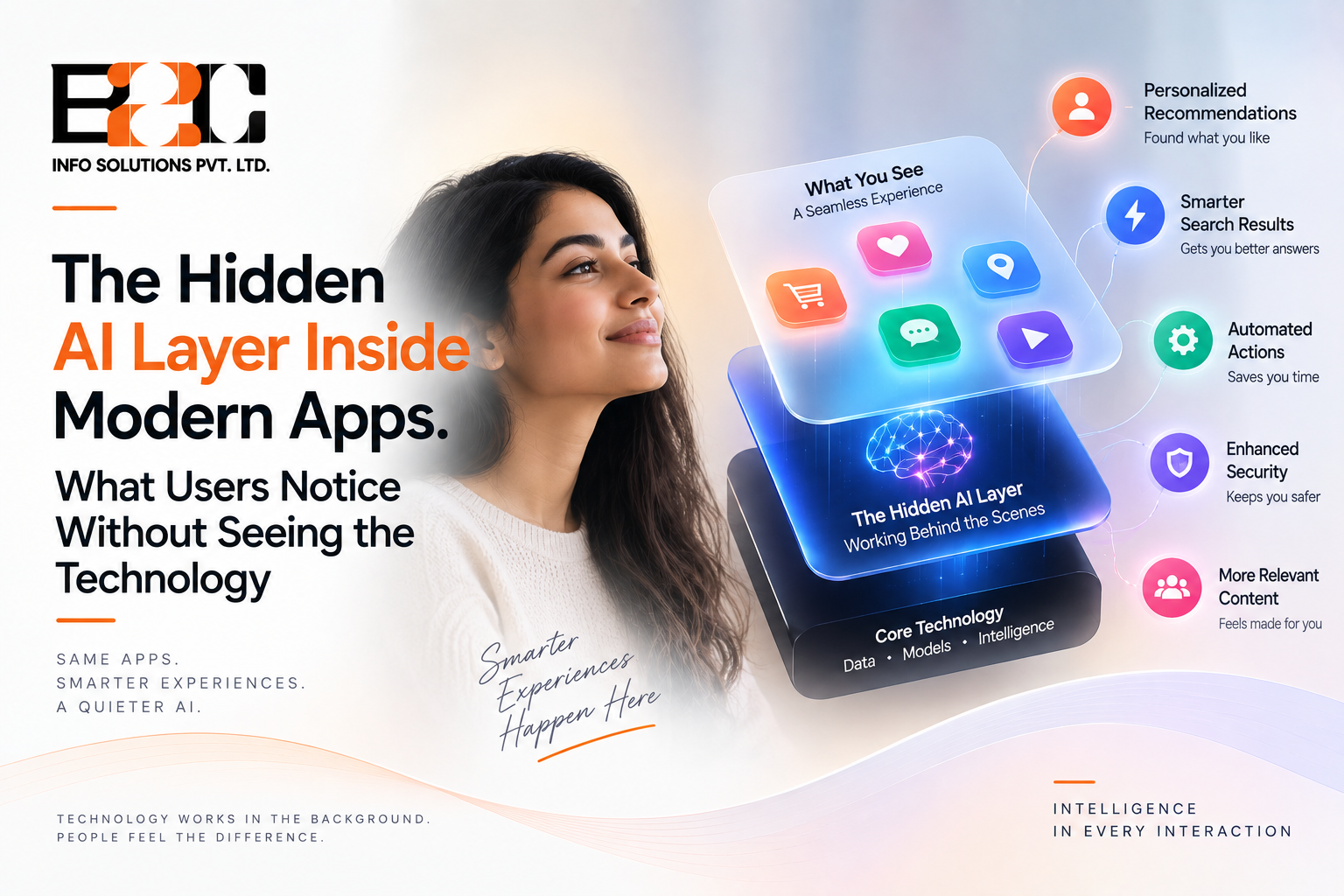
Open almost any app on your phone today, and somewhere behind the screen a decision is being made without a single visible cue announcing it. A product feed reorders itself around what you tend to browse. A support chat resolves a question before a human agent even sees it. None of this looks like "AI" in the way headlines usually describe it. It simply looks like the app working well. This quiet shift is the kind of work a mobile app development company in the USA has been building toward for a while now: intelligence that fades into the experience instead of announcing itself.
A hidden AI layer is not a chatbot bolted onto a homepage or a flashy "Ask AI" button. It refers to models, algorithms, rules, and supporting systems that operate behind the interface, shaping what a user sees, in what order, and how quickly, without ever labeling themselves as artificial intelligence. Users do not open a menu to turn it on. They simply notice that a search returns better results, that a feed feels relevant, or that an error message shows up before something actually breaks.
Not every background decision system is AI. Some rely on conventional business rules, search algorithms, statistical methods, or deterministic logic instead of a trained model. The distinction matters because the appropriate testing, monitoring, and governance approach can differ depending on which of these is doing the work.
This distinction matters for how apps are researched and built. Visible AI features tend to get more marketing attention. Invisible ones can require substantial engineering investment because they may influence multiple parts of the user experience rather than a single feature.
The term "hidden" here does not mean secretive in a negative sense. It simply describes a design approach where the technology is a means to a better outcome, rather than the outcome itself. A user does not need to know that a ranking model is running to benefit from a more relevant list of results.
Much of today's personalization can use behavioral signals rather than explicit preferences. An app tracks what a user lingers on, skips, or returns to, and quietly adjusts what comes next.
A fitness app might surface beginner routines to a new sign-up and strength-focused programs to someone who has already logged several intense sessions, without ever asking the user to select a "level." The reordering is the product of a recommendation model, not a manual rule someone wrote for every user type.
Traditional in-app search often relied heavily on keyword matching. Modern search systems can also use natural language processing, semantic retrieval, or other ranking techniques to better interpret user intent. A grocery app that returns "low-sugar snacks" for a search of "healthy treats" is applying this kind of intent matching, even though nothing in the interface says so.
Banking, wallet, and e-commerce systems may run automated checks that compare transactions against established risk signals and behavioral patterns. When a purchase looks unusual, the app may ask for extra verification. Users experience this as "the app being careful," not as a model scoring risk in the background.
Some apps preload likely next screens or resources based on navigation patterns and other usage signals. The result feels like speed. Predictive prefetching like this can be implemented using conventional statistical or rule-based techniques as well as machine learning.
None of these examples require a user-facing label. A traveler booking a flight who sees relevant seat upgrades, or a shopper whose cart page loads without a visible delay, is experiencing the outcome of this layer rather than the mechanism behind it.
People rarely credit "the algorithm" when an app feels intuitive. They describe it as the app being well designed, fast, or easy to use. This is not an accident of perception; it reflects how well the underlying system has been tuned to stay out of the way.
An AI layer that constantly interrupts, over-explains itself, or asks for confirmation on routine tasks tends to feel intrusive rather than smart. One pattern many product teams now follow is to only surface AI-driven suggestions when evaluation indicates that they are likely to be useful and relevant, and to let everything else run silently in the background. This is less about hiding the technology and more about respecting a user's attention.
Making AI work reliably as an invisible part of an app can be more demanding than implementing a narrowly scoped visible feature. A chatbot can fail loudly and still be forgiven as "still learning." A background recommendation engine that gets things wrong quietly erodes trust without anyone quite knowing why.
Behind every personalized feed or predictive suggestion sits a pipeline that collects, cleans, and feeds behavioral data into a model, sometimes in near real time as users interact with the application. Poorly built pipelines lead to stale or irrelevant suggestions, which users notice even if they cannot name the cause.
Because invisible AI can rely on behavioral or contextual data, teams also need to consider data minimization, access controls, retention, and applicable privacy requirements alongside model performance.
Not every hidden feature needs a large language model. Many of the AI layers described above rely on smaller, purpose-built models chosen specifically because they respond fast enough to feel instant. Teams working with an experienced AI development company in the USA may weigh model size, accuracy, cost, and response time early in the design process, since a slow or expensive model can undo the benefit of an accurate one.
Because this layer is often invisible to users, some failures may not be immediately obvious until they appear in engagement metrics, quality measurements, or support reports. Careful teams build monitoring specifically for these failure modes, rather than assuming a lack of complaints means the system is working.
Invisibility is a design choice with trade-offs, not a universal good. When a system quietly shapes what a user sees, pricing they are offered, or content they are shown, some transparency becomes necessary, particularly in contexts where the outcome has real financial or personal consequences.
A recommendation engine choosing a movie is low stakes. A model influencing credit decisions, insurance-related outcomes, or health-related recommendations carries much higher potential consequences. In higher-impact categories, the appropriate level of human oversight and disclosure should reflect the potential consequences of an incorrect or biased output, along with applicable legal and regulatory requirements, rather than following a single fixed rule across every industry.
Some apps now include a small "why am I seeing this" option next to personalized content. It is a modest feature, but it acknowledges that invisible does not have to mean unaccountable. Giving users an understandable explanation of why content or recommendations appear can improve transparency and give them greater visibility into the system.
For product teams and founders, the practical takeaway is that AI adoption should not be measured by how many AI features are listed on a landing page. It should be measured by whether the app feels noticeably better to use, day after day, without extra friction.
This shifts the conversation with a development partner. Instead of asking "can you add an AI chatbot," product teams can increasingly consider how intelligence might be woven into search, onboarding, fraud detection, and navigation, so the improvement is felt more broadly rather than confined to one screen. This kind of work is less about a single feature and more about a set of decisions made across the entire app architecture, from data collection to interface design.
It also changes how success gets measured internally. Instead of tracking how many people clicked an "AI" badge, teams can evaluate these systems using product metrics such as retention, task completion time, conversion, error rates, and support ticket volume, depending on the feature's objective.
The most effective AI inside modern apps is often the AI users never think about. It shows up as a feed that feels right, a search that understands what was meant, and a checkout that flags a problem before it becomes one. Building that kind of layer takes deliberate engineering choices around data, model selection, and testing, not just access to a model API. Teams looking to add this kind of intelligence to an existing product, or plan it into a new one from the start, can contact us to discuss what a hidden AI layer could look like for their specific app.
It refers to AI models and systems that influence what a user sees or experiences, such as personalization, search ranking, or fraud checks, without being presented to the user as a distinct "AI feature."
A chatbot is a visible, opt-in feature a user actively engages with. A hidden AI layer runs continuously in the background, shaping the experience whether or not the user interacts with anything labeled as AI.
It can, particularly when the AI influences decisions with financial, health, or legal consequences. Many teams address this by adding lightweight explanations or disclosures in higher-impact areas, while leaving low-stakes personalization to run without extra prompts.
It can require more upfront engineering when it needs to integrate with multiple parts of an existing application, particularly when monitoring and evaluation must also be added. The cost depends heavily on the scope and the existing app architecture.
The usual starting point is identifying one or two areas, such as search, onboarding, or personalization, where user behavioral data already exists, and building a focused model for that area before expanding further.

 4 North
  52 Cornmarket
  C-25, C Block, 91springboard
 #02 - 161 IMM Building