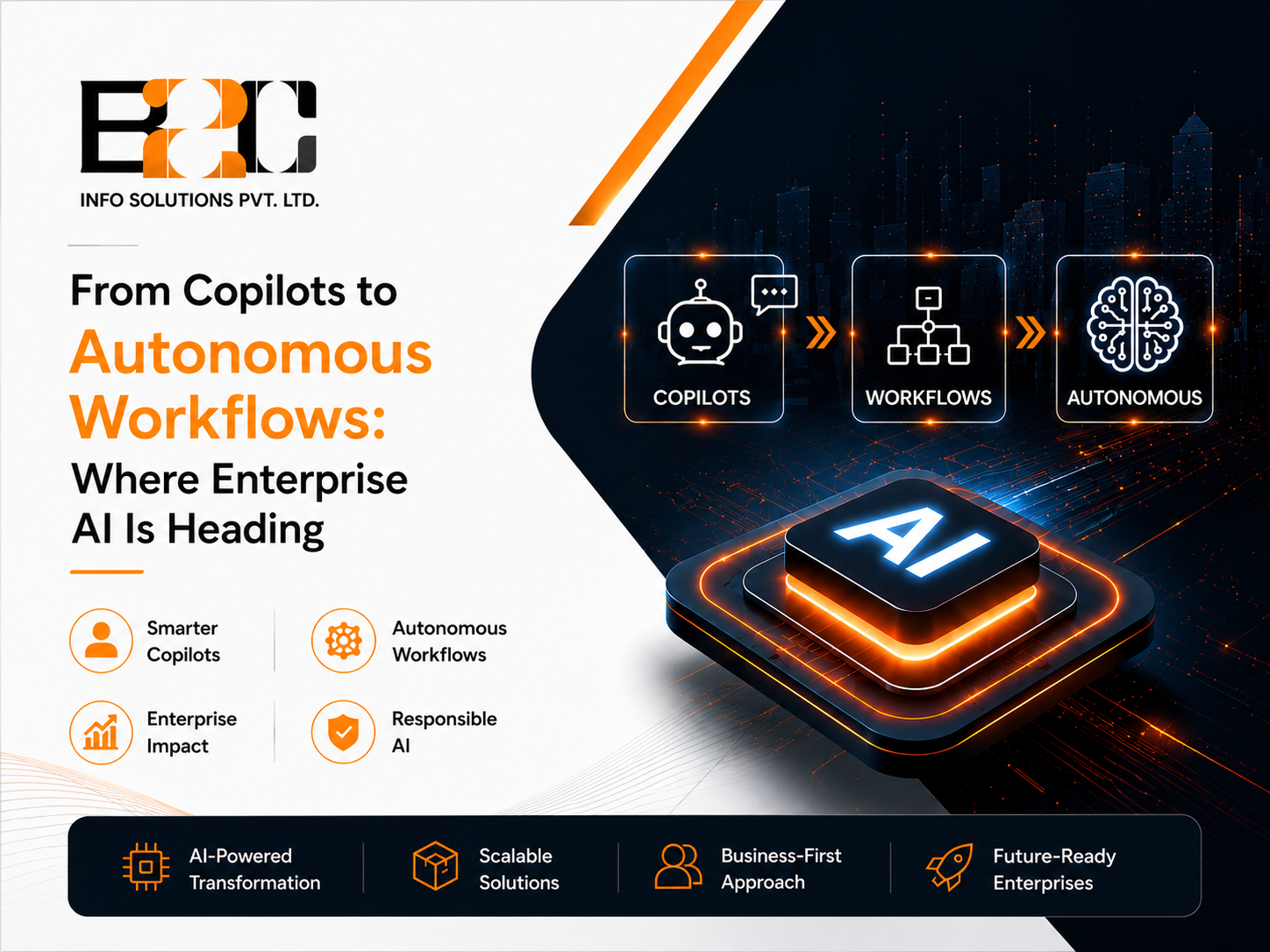
For the last two years, much of the enterprise generative AI conversation has centered on copilots: AI systems that help employees draft, summarize, search, and answer questions. In 2026, that model is increasingly being supplemented by AI agents that can take actions and coordinate multi-step workflows. Organizations working with an AI development company in the USA are now building systems that plan, execute, and complete multi-step tasks with reduced human input. The shift is not cosmetic. It changes how work gets done, who is accountable for outcomes, and what "using AI" actually means inside a business.
Copilots were built around a simple loop: a person asks, the model answers, a person acts on that answer. This worked well for isolated tasks like drafting a report or summarizing a document, but it left the coordination, sequencing, and follow-through largely on human shoulders. As adoption matured, many enterprises found that individual productivity gains from copilots did not always translate into faster end-to-end processes, because a human still had to stitch each step together manually.
That gap is what autonomous workflows are designed to close. Instead of assisting one step at a time, an autonomous system is given an outcome to reach, a set of tools it can use, and boundaries it must respect. It then plans the sequence of actions needed and carries the work forward, checking in with people when a decision requires judgment or approval. Copilots are not disappearing in this shift; they are being supplemented by agents that take on more of the execution itself.
A copilot typically assists a person with a task, while an agent can be given a goal and the tools needed to execute multiple steps toward that goal, within defined permissions and constraints. Where a copilot might draft a reply to a customer, an agent built for autonomous execution can read the incoming request, check order history across systems, generate the response, route it for approval if the value exceeds a threshold, and close the ticket once resolved. The human role moves from doing the task to setting the rules the task must follow.
The technical shift behind this change is just as important as the conceptual one. Many current agent architectures combine capabilities such as persistent or retrieved context, external tool and API access, and the ability to adapt their next action based on new information or tool results. Memory and tool access vary considerably between implementations, and not every agent deployed today carries context across sessions, but the direction of the underlying architecture is what allows some agents to handle a workflow that spans several applications rather than a single conversation.
Many organizations have seen productivity gains from copilots, but those gains do not automatically translate into faster end-to-end processes. Deloitte's 2026 research found that 37% of surveyed organizations were still using AI at a surface level, with little or no change to underlying business processes, while only 30% reported redesigning key processes around AI. That gap is prompting leaders to ask a harder question: what happens if the software itself takes on more of the handoffs between steps?
The shift is real, but enterprise adoption of autonomous agents is still early. Deloitte's August 2026 research found that 42% of surveyed organizations had tested or deployed AI agents, while only 15% had scaled orchestrated, cross-functional multi-agent adoption. The same research identified unified data access, trust and governance, and integration complexity as the leading barriers to scaling further.
Falling model costs and improving inference performance are making some agentic workloads more economically practical, although the cost of multi-step agent execution still depends heavily on the model chosen, workflow complexity, tool usage, context size, and the number of retries required. Where the economics do work out, an agent can attempt a task, verify the result, and retry if needed, often within the time a human would have spent reading a single suggestion.
This combination of pressure and capability is why many companies are turning to an AI development partner in the USA to redesign core processes around autonomous execution rather than adding an assistant on top of an existing workflow.
An autonomous workflow typically starts with a defined goal rather than a single instruction. A finance team, for example, could configure an agent to reconcile invoices against purchase orders, flag mismatches above a set variance, and route only the exceptions to a human reviewer. Implementations like this depend on the right integrations and controls being in place; they are not something an agent does automatically without setup.
Because these systems are built to call tools, they can move across applications that previously required manual switching, when properly integrated. An agent handling customer onboarding, for instance, might pull identity data from one system, create records in a CRM, trigger a compliance check through a separate service, and send a welcome sequence, all inside one continuous run.
In order-to-cash processes, a properly configured agent can validate a new order against inventory and credit limits, generate the invoice, monitor payment status, and escalate overdue accounts to collections staff with a summary of prior contact. None of these steps is new to automation on its own, but connecting them with less manual handoff in between is what marks the difference between assisted work and autonomous execution.
Autonomy raises a question copilots rarely had to answer: what is this system actually allowed to do, and who is responsible when it gets something wrong. Giving an agent access to customer records, payment systems, or external communications turns it into an operational actor, not just a productivity tool. Enterprises are responding by defining explicit permission boundaries, spending limits, and audit trails for every action an agent can take, similar to how they manage access for employees.
The governance gap is still significant. Deloitte's 2026 State of AI in the Enterprise research found that only 21% of surveyed organizations had a mature governance model for autonomous AI agents, with defining boundaries, monitoring agent behavior, and maintaining audit trails cited as ongoing challenges.
Human oversight remains important for many enterprise deployments, particularly where decisions involve significant financial, legal, operational, or reputational consequences. A practical approach is often tiered: agents can handle high-volume, well-defined tasks independently, while higher-risk or ambiguous decisions are routed to people for review.
Moving fast on autonomy without addressing the underlying process can make failures worse, not better, because a flawed workflow now runs at machine speed instead of human speed. Enterprises that treat governance as an afterthought tend to see these issues surface only after an incident, which is more costly than designing for them up front.
A practical starting point is often a narrow, high-volume process, such as invoice matching, ticket triage, or routine reporting, where the boundaries are clear and the cost of an error is low. Results from a bounded pilot can build the internal confidence and technical foundation needed to extend autonomy into more complex, higher-stakes workflows.
Building this kind of infrastructure internally takes specialized experience in agent architecture, integration, and governance. A technology partner with experience in these areas, such as an enterprise AI solutions provider based in the US, can help organizations navigate these challenges more systematically.
The shift from copilots to autonomous workflows is still early, and not every process is a good candidate for it. Tasks that are repetitive, well-documented, measurable, and relatively low-risk are often better candidates for early experimentation. Work that depends on nuanced judgment or shifting context will likely stay human-led for some time, supported rather than replaced by AI. The enterprises that benefit most will be the ones that treat this as a redesign of how work flows through the organization, not simply a new tool added to an old process.
Enterprise AI is moving past chat-based assistance and into the harder, more valuable work of executing processes end-to-end. That transition demands new thinking about governance, data quality, and where human judgment should sit inside a workflow. Getting the foundation right matters more than moving fastest. If your organization is weighing where to start, contact us to talk through which processes are ready for autonomous execution and which still need a human at the center.
A copilot typically assists a person with a task and leaves the next action to them. An agent can be given a goal and the tools needed to execute multiple steps toward that goal, within defined permissions and constraints, and it pauses for human input mainly when a decision falls outside those boundaries.
It can be used safely for appropriate enterprise workflows when organizations define clear permission scopes, implement monitoring and logging, test failure modes, and require human review for high-risk or ambiguous decisions. Safety comes from governance design, not from the technology alone.
Processes that are repetitive, well-documented, measurable, and relatively low-risk, such as invoice reconciliation, ticket triage, or routine reporting, are often better starting points. They let teams validate the approach before extending autonomy into more complex or judgment-heavy work.
Not typically. A tiered model can allow agents to handle high-volume, well-defined tasks independently while routing higher-risk or ambiguous decisions to people for approval.
Timelines vary significantly by workflow complexity, data readiness, integration requirements, security controls, and approval processes. A bounded pilot is often a more practical starting point than attempting an organization-wide rollout immediately.

 4 North
  52 Cornmarket
  C-25, C Block, 91springboard
 #02 - 161 IMM Building