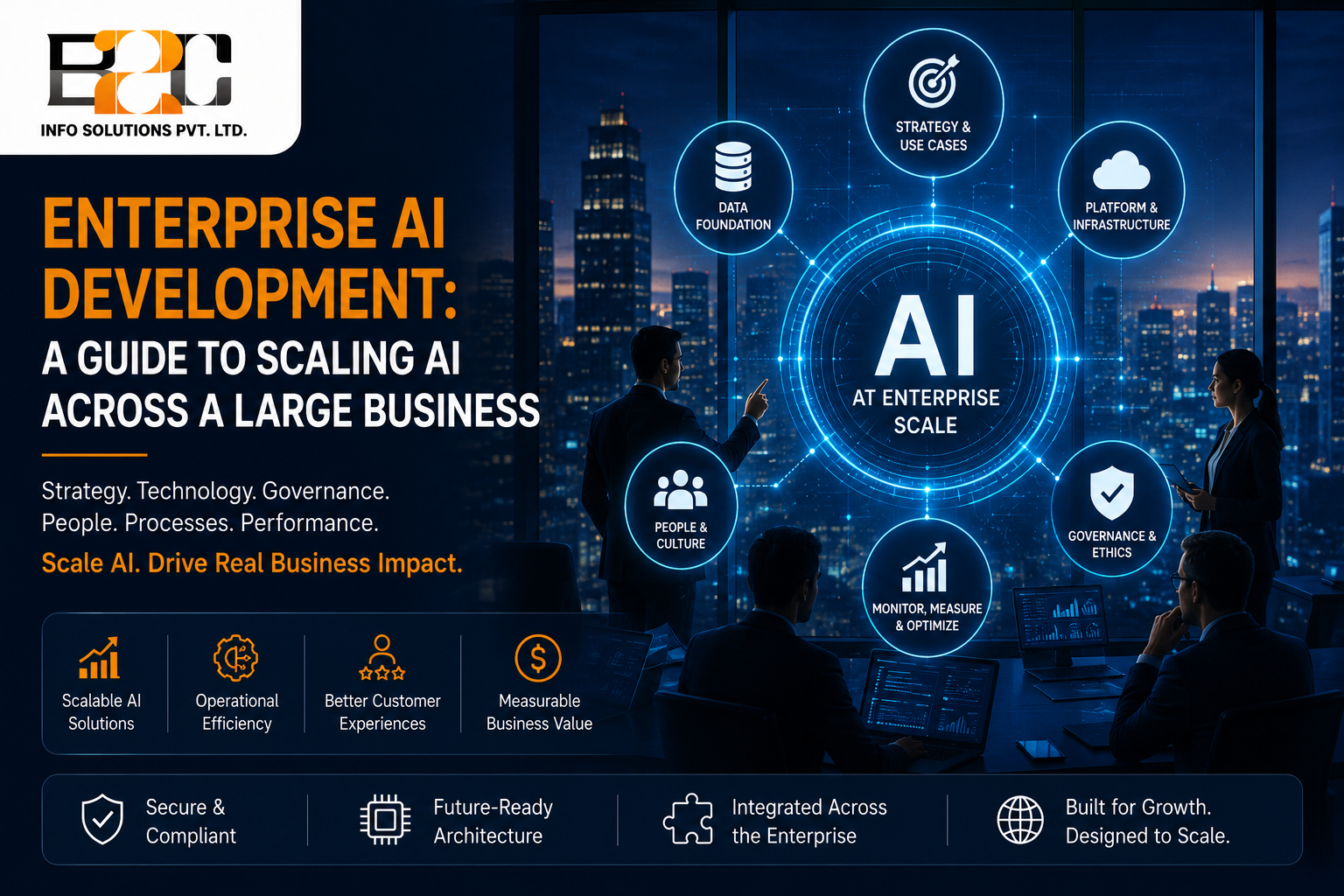
Quick answer: Enterprise AI development is the work of taking artificial intelligence beyond a single experiment and embedding it reliably across a large organisation. It succeeds not on the strength of one clever model, but on data foundations, governance, integration, and change management that let AI run safely at scale. The hard part of enterprise AI is rarely the model; it is everything around it.
A small AI project and an enterprise AI programme are different in kind, not just in size. A startup can wire up a single model, connect it to one system, and iterate freely. A large organisation cannot. It has many systems that must work together, strict security and compliance obligations, thousands of users, and a low tolerance for a system that behaves unpredictably. Enterprise AI development is the discipline of meeting those constraints so that AI becomes a dependable part of how the business runs, rather than a promising demo that never leaves the lab.
This is why so many corporate AI pilots stall. The model works in isolation, but the organisation lacks the data foundation, the governance, or the integration to put it into production safely. The companies that succeed treat AI as an operating capability to be built deliberately, not a feature to be switched on. The result is worth the effort: AI applied consistently across an enterprise compounds in value in a way that scattered experiments never do.
Delivering at this level is the remit of an AI development company in India with the engineering depth to handle complex systems, and, for organisations serving American markets, an AI development company in the USA that understands local compliance expectations.
A durable enterprise AI capability rests on six pillars. Weakness in any one of them is usually where a programme fails.
Enterprise AI begins with a clear view of which use cases matter most, ranked by business impact and feasibility. Without this, effort scatters across too many pilots and none reaches real scale. A costed roadmap tied to measurable outcomes keeps the programme focused.
Large organisations hold vast but fragmented data, spread across systems that were never designed to work together. Building a reliable, governed data foundation is often the largest and most important part of enterprise AI, because every model depends on it.
At scale, an AI system can affect thousands of decisions, so governance is essential. This means role based access, audit trails, documented data lineage, and bias testing on decisions that affect people, so the organisation can stand behind every outcome under internal and external scrutiny.
A model creates value only when it is connected to the systems the business runs on, such as CRM, ERP, and data platforms, through secure APIs. Enterprise integration is demanding, and it is where many otherwise sound models fail to deliver.
Enterprise models must stay accurate for years, not weeks. MLOps provides the versioning, monitoring, and scheduled retraining that keep them dependable as data and conditions change, with alerts when performance drifts.
Technology is only half the challenge. People must trust and adopt the system, which means training, clear communication, and designing AI to support staff rather than alarm them. Programmes that ignore this see strong systems go unused.
Across large organisations, a consistent set of applications delivers the most value, because they attack high volume, high cost processes.
|
Function |
Enterprise AI use case |
Outcome |
|---|---|---|
|
Customer service |
Grounded assistants across channels |
Lower cost, faster resolution |
|
Finance |
Fraud detection and forecasting |
Reduced loss, better planning |
|
Operations |
Process automation with agents |
Less manual coordination |
|
HR |
Document and query automation |
Faster internal service |
|
Knowledge |
Search across internal content |
Staff find answers quickly |
Successful enterprises rarely leap straight to organisation wide AI. They move through three stages, each building on the last.
Rushing this path is a common mistake. An organisation that tries to embed AI everywhere before proving it anywhere usually ends with cost and confusion. Moving deliberately through the stages builds both capability and trust.
Enterprises rarely need to train a model from scratch. Most build on established foundation models and add their own data, governance, and integration on top. The main options in 2026 include OpenAI GPT (GPT-4.1 and GPT-5), Anthropic Claude, and Google Gemini among the hosted commercial models, and Meta Llama and Mistral among the open source families. Each has strengths, so a capable partner stays model agnostic and selects based on accuracy, cost, privacy, and hosting needs rather than loyalty to one vendor.
For enterprises, the hosting question is often decisive. A hosted commercial model through an API is fast and powerful, and suits many use cases. But where data is highly sensitive or regulation requires it to stay within the organisation's control, an open source model deployed in a private or on premise environment may be the only acceptable route. This is a governance decision as much as a technical one, and it is exactly the kind of trade off that separates enterprise AI from a simple pilot. The ability to run different models for different use cases, under one consistent governance framework, is a hallmark of a mature enterprise AI capability.
Not every organisation is ready to scale AI, and recognising the signs saves wasted effort. You are ready when leadership backs AI as a priority rather than a side experiment, when you can identify specific high value use cases rather than a vague ambition to use AI, and when you have data that, even if messy, exists and can be brought into a governed foundation. You are also ready when there is appetite to invest in the unglamorous groundwork of data and governance, not just the visible model. If those conditions are absent, the right first move is a focused pilot that builds the case, rather than a large programme that will struggle to find traction. Honest assessment here is far cheaper than a stalled initiative later.
For a large organisation, the risks of AI are as real as the rewards. A model that makes biased decisions, exposes sensitive data, or behaves unpredictably can cause regulatory, financial, and reputational harm at a scale a small company would never face. This is why governance sits at the centre of serious enterprise AI, rather than at the edge. Encryption, access control, audit trails, bias testing, and human oversight on sensitive decisions are what allow an enterprise to adopt AI with confidence. A partner that treats these as afterthoughts is a poor fit for enterprise work, however capable its models.
It is building artificial intelligence that runs reliably across a large organisation, covering strategy, data foundations, governance, integration, operations, and adoption, rather than a single isolated model or pilot.
Usually because the model works in isolation but the organisation lacks the data foundation, governance, or integration to put it into production safely. Success depends on those surrounding foundations as much as the model itself.
With a focused pilot on one high value use case and a clear metric, then scaling the proven approach and finally embedding it. This staged path builds capability and trust while containing risk.
It is essential. At enterprise scale, AI affects many decisions and sensitive data, so access control, audit trails, bias testing, and human oversight are what make adoption safe and defensible.
Many enterprises begin with a specialist partner to move quickly and access scarce skills, then build internal capability over time as use cases multiply. A partner brings proven process, engineering depth, and governance from day one, while an in house team develops gradually. The two are complementary rather than mutually exclusive.
Enterprise AI development is less about a single model and more about the strategy, data, governance, integration, and adoption that let AI run safely at scale. Move through pilot, scale, and embed deliberately, and treat governance as central rather than optional. To plan an enterprise AI programme that reaches production rather than stalling as a pilot, the team at B2C Info Solutions can help you build the foundations and prioritise the use cases that matter most.
About the Author
Jitendra Tomar (JS Tomar) is the Global Business Head at B2C Info Solutions, a premium digital technology company that has delivered more than 1000 web and mobile projects worldwide. With a deep background in strategic formulation and product engineering, he specializes in helping businesses leverage AI, cloud, and experience design to build disruptive software solutions.
Based in Noida, JS is dedicated to nurturing a culture of excellence and delivering high-value digital transformations for clients across North America, Europe, and the Middle East.

 4 North
  52 Cornmarket
  C-25, C Block, 91springboard
 #02 - 161 IMM Building