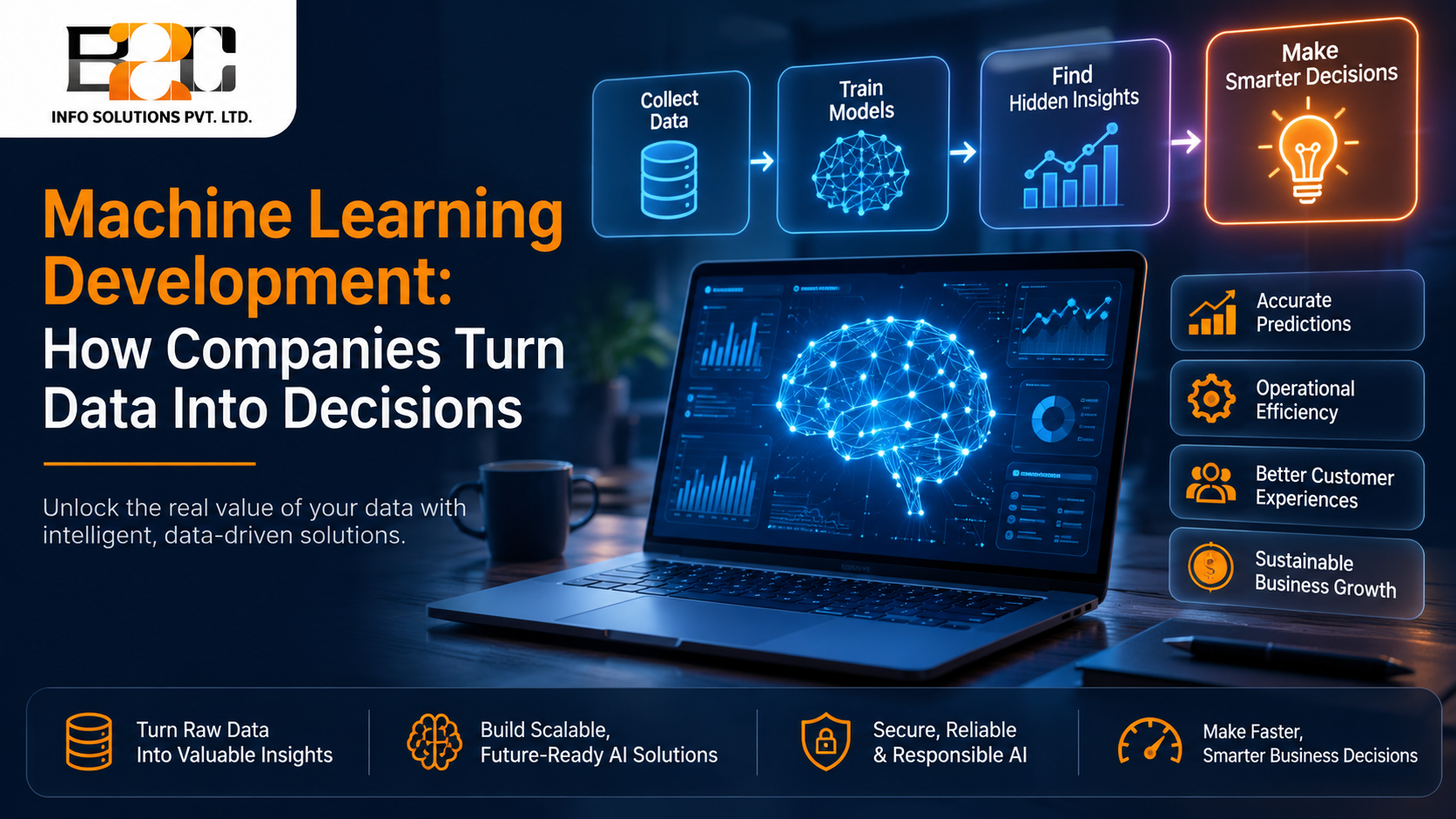
Short answer: Machine learning development is the work of turning your historical data into models that predict, classify, or recommend, so that decisions once made on instinct can be made on evidence. It follows a repeatable path from raw data to a live, monitored model, and it is the engine behind forecasting, fraud detection, personalisation, and much more.
Machine learning is a branch of artificial intelligence in which software learns patterns from data rather than following rules a person wrote by hand. Machine learning development is the engineering discipline of building, training, and running those models so they work reliably on real business problems. Where a traditional program is told exactly what to do, a machine learning model is shown many examples and learns the relationship between them, then applies what it learned to new cases it has never seen.
The practical result is a shift from guesswork to evidence. A retailer can move from estimating next month's demand to predicting it from years of sales history. A lender can move from rigid rules to a model that scores risk from thousands of past outcomes. A support team can move from manual sorting to a model that routes each request automatically. In every case, the value comes from a decision made more accurately, more consistently, and at greater scale than a person could manage.
Delivering this well is a core part of what an AI development company in India does, pairing data scientists who shape the models with engineers who put them into production.
A dependable machine learning project follows a clear sequence. Skipping steps is the most common reason models fail in the real world, so each stage matters.
Before any data is touched, the team defines the decision the model will support and the metric that will judge success. A vague goal produces a vague model, so this framing shapes everything that follows.
Raw business data is messy: missing values, duplicates, and inconsistent formats are the norm. The team cleans and structures it into a reliable foundation. This stage is usually the largest, because the quality of the data sets a hard ceiling on how good the model can be.
Features are the signals the model learns from. Turning raw fields into meaningful inputs, for example converting a date of birth into an age band or a purchase history into a frequency score, is often what separates a mediocre model from a strong one.
The team selects an algorithm suited to the problem and trains it on the prepared data, letting it learn the patterns that link inputs to the outcome you care about. Several approaches are usually tried and compared.
The model is checked on data it has never seen, to confirm it genuinely learned the pattern rather than memorising the training set. Accuracy, fairness, and stability are all assessed against the metric agreed at the start.
A model only creates value once it is live and connected to your systems. After deployment, it is watched for drift, the slow decline in accuracy as the world changes, and retrained on a schedule so it stays dependable.
Most business use cases map to one of a few problem types. Recognising which you have makes the path much clearer.
|
Problem type |
What it answers |
Business example |
|---|---|---|
|
Prediction (regression) |
How much or how many? |
Forecasting next month's sales |
|
Classification |
Which category does this belong to? |
Flagging a transaction as fraud or not |
|
Clustering |
Which things are similar? |
Grouping customers into segments |
|
Recommendation |
What should come next? |
Suggesting the next product to a shopper |
|
Anomaly detection |
What looks unusual? |
Spotting equipment likely to fail |
Underneath these problem types sit three broad ways a model can learn, and knowing the difference helps you understand what a project involves.
Supervised learning is the most common in business. The model learns from labelled examples, cases where the answer is already known, such as past transactions marked as fraud or genuine. It then applies that learning to new cases. Prediction and classification both rely on it, which is why supervised learning powers most forecasting, scoring, and detection systems.
Unsupervised learning works without labels. Instead of being told the answer, the model finds structure in the data on its own, grouping similar items together. Customer segmentation is a classic example: the model discovers natural clusters of buyers that no one defined in advance, which the business can then act on.
Reinforcement learning is different again. Here the model learns by trial and feedback, taking actions and adjusting based on the reward or penalty that follows. It suits problems such as optimising a sequence of decisions over time, and while it is more specialised, it powers areas like dynamic pricing and certain kinds of automation. Most business projects begin with supervised learning, because labelled historical data is usually the easiest starting point and the results are straightforward to measure.
The same handful of model types power a wide range of outcomes across industries. A few of the most common and highest return uses show the pattern.
It is tempting to think the algorithm is the hard part, but experienced teams know better. A sophisticated model trained on poor data will underperform a simple model trained on clean, relevant data, every time. Gaps, errors, and bias in the source data flow straight through into the model's predictions, and no amount of tuning fully removes them. This is why a serious machine learning partner spends heavily on data preparation and is honest when the data is not yet ready. If a provider promises a strong model without first examining your data, treat that as a warning sign rather than a reassurance.
The lowest risk way to begin is with one well chosen problem rather than a sweeping programme. Pick a decision that is made often, matters to the business, and has data behind it. Prove a model on that single case, measure it honestly against the metric set at the start, and only then expand to the next. This measured approach builds internal confidence, keeps the budget contained, and produces evidence that the investment works before it grows.
It also helps to be realistic about what a first model will and will not do. Early models rarely reach their best accuracy immediately; they improve as more data arrives, as features are refined, and as the team learns from real predictions. Treating the first version as a starting point rather than a finished product sets the right expectation and leads to a stronger system over time. The businesses that succeed with machine learning are usually those that commit to this cycle of measure and improve, rather than expecting a perfect result on day one.
It is the engineering work of building, training, and running models that learn patterns from your data to predict, classify, or recommend. It covers the full path from data preparation through deployment and monitoring.
Machine learning models predict or classify from your data, such as forecasting demand or detecting fraud. Generative AI creates new content such as text or images. Many real systems combine both, for example a prediction feeding a generative assistant.
It depends on the problem, but quality matters more than raw volume. Clean, relevant, well labelled data produces better models than a larger but messy dataset. A good partner assesses your data before committing to an approach.
A focused first model can often be proven in a matter of weeks, with most of that time spent preparing data. Full production timelines depend on integration depth and how much data cleaning is required.
Not to get started. A specialist partner provides the data scientists and machine learning engineers, along with the process to run a project properly. Many businesses begin with an external team, then decide later whether to build internal capability once the value is proven and the use cases multiply.
Machine learning development turns the data you already hold into decisions made on evidence rather than instinct, through a disciplined lifecycle where data quality matters most. Start with one high value problem, prove it, and expand from there. To identify the decision in your business that machine learning could sharpen first, the team at B2C Info Solutions can help you frame the problem and assess whether your data is ready.
About the Author
Jitendra Tomar (JS Tomar) is the Global Business Head at B2C Info Solutions, a premium digital technology company that has delivered more than 1000 web and mobile projects worldwide. With a deep background in strategic formulation and product engineering, he specializes in helping businesses leverage AI, cloud, and experience design to build disruptive software solutions.
Based in Noida, JS is dedicated to nurturing a culture of excellence and delivering high-value digital transformations for clients across North America, Europe, and the Middle East.

 4 North
  52 Cornmarket
  C-25, C Block, 91springboard
 #02 - 161 IMM Building